
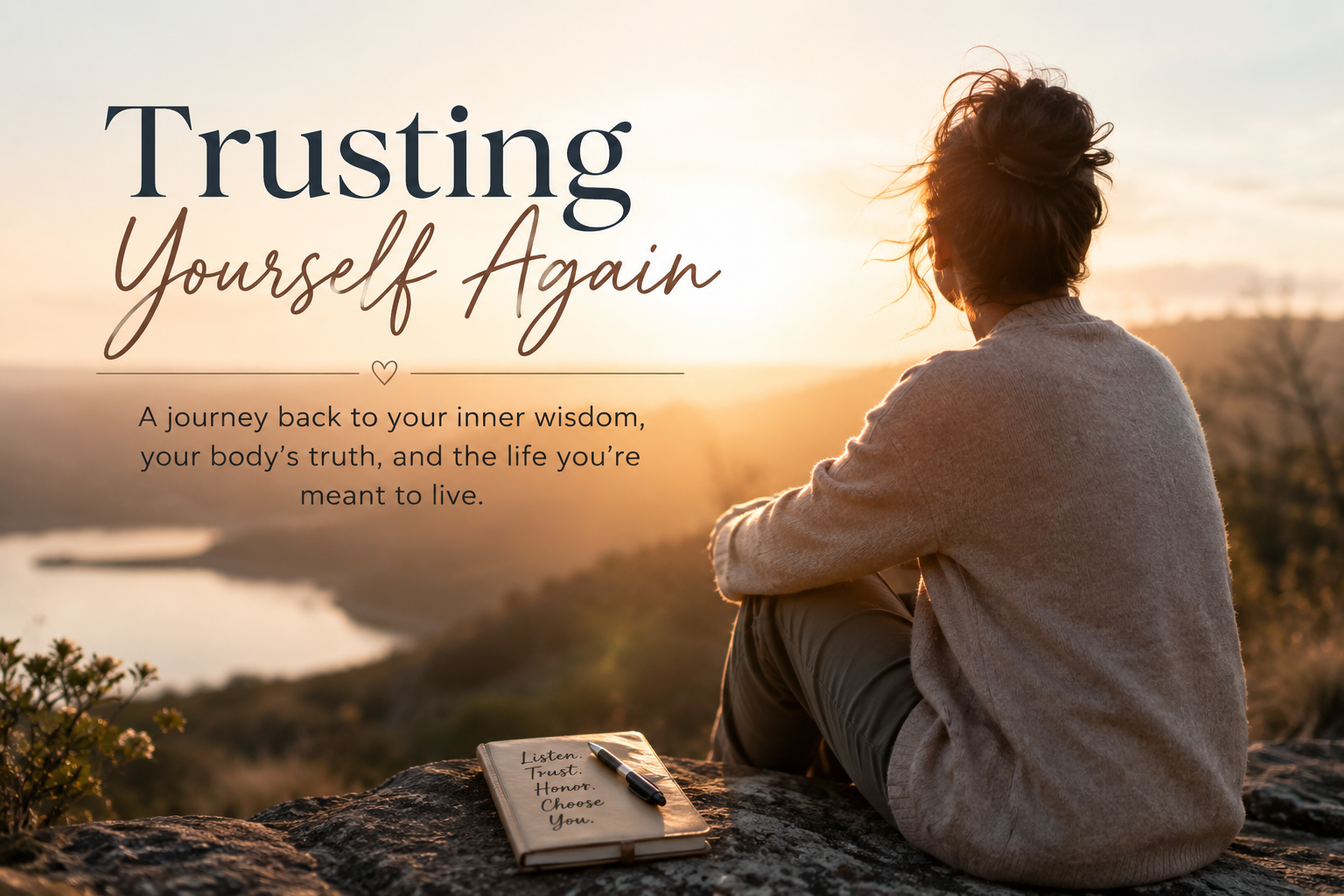
Self-trust begins the moment we stop searching for answers everywhere else and start listening to the quiet wisdom that has been within us all along.
When we begin paying attention differently, something remarkable happens. We start seeing things we have overlooked for years. The patterns. The assumptions. The habits of thought that quietly shaped our choices.
Sometimes we discover that fear, approval-seeking, perfectionism, or people-pleasing have been sitting in the driver's seat for far longer than we realized.
When we lose touch with our sense of purpose or our ability to exercise agency, it becomes easy to look outward for direction. We allow others to define what success looks like. What matters. Who we should be. What choices we should make.
And over time, we can become disconnected from one of our greatest sources of wisdom: ourselves.
The Search for External Validation
Many of us learn early in life to seek answers outside ourselves.
I certainly did.
Several years ago, when I first began writing professionally, my boss called me into her office to discuss a story I had submitted.
She looked at me and asked a simple question: "Is this the story you wanted to write?"
Honestly, it wasn't.
I had written the story I thought others wanted. The story that felt safe. The story that would be approved.
She paused, handed the pages back to me, and said something I have never forgotten: "You have great instincts. You need to trust them and follow them."
Then she told me to write the story I actually wanted to write.
Looking back, that may have been the first time in my professional life someone encouraged me to trust my own intuition.
After that conversation, I began paying closer attention to the quiet voice inside me.
Intuition Versus Impulse
At first, I discovered that trusting myself wasn't nearly as straightforward as it sounded.
I didn't always know the difference between intuition and impulse.
Since childhood, I had been an impulsive person. I was accustomed to acting quickly, chasing excitement, responding to strong emotions, and following sudden urges.
The challenge was that impulse can masquerade as intuition.
Both can feel immediate.
Both can feel compelling.
But they are not the same.
Impulse often arrives with urgency. It is fueled by emotion, adrenaline, fear, excitement, attraction, or the desire for immediate relief. It says, Act now.
Intuition tends to be quieter. It rarely shouts. Instead, it presents itself as a steady knowing. A subtle sense that something is right—or wrong—even when we can't fully explain why.
One creates urgency.
The other creates clarity.
Learning to distinguish between the two became one of the most important skills of my life.
The Wisdom of the Body
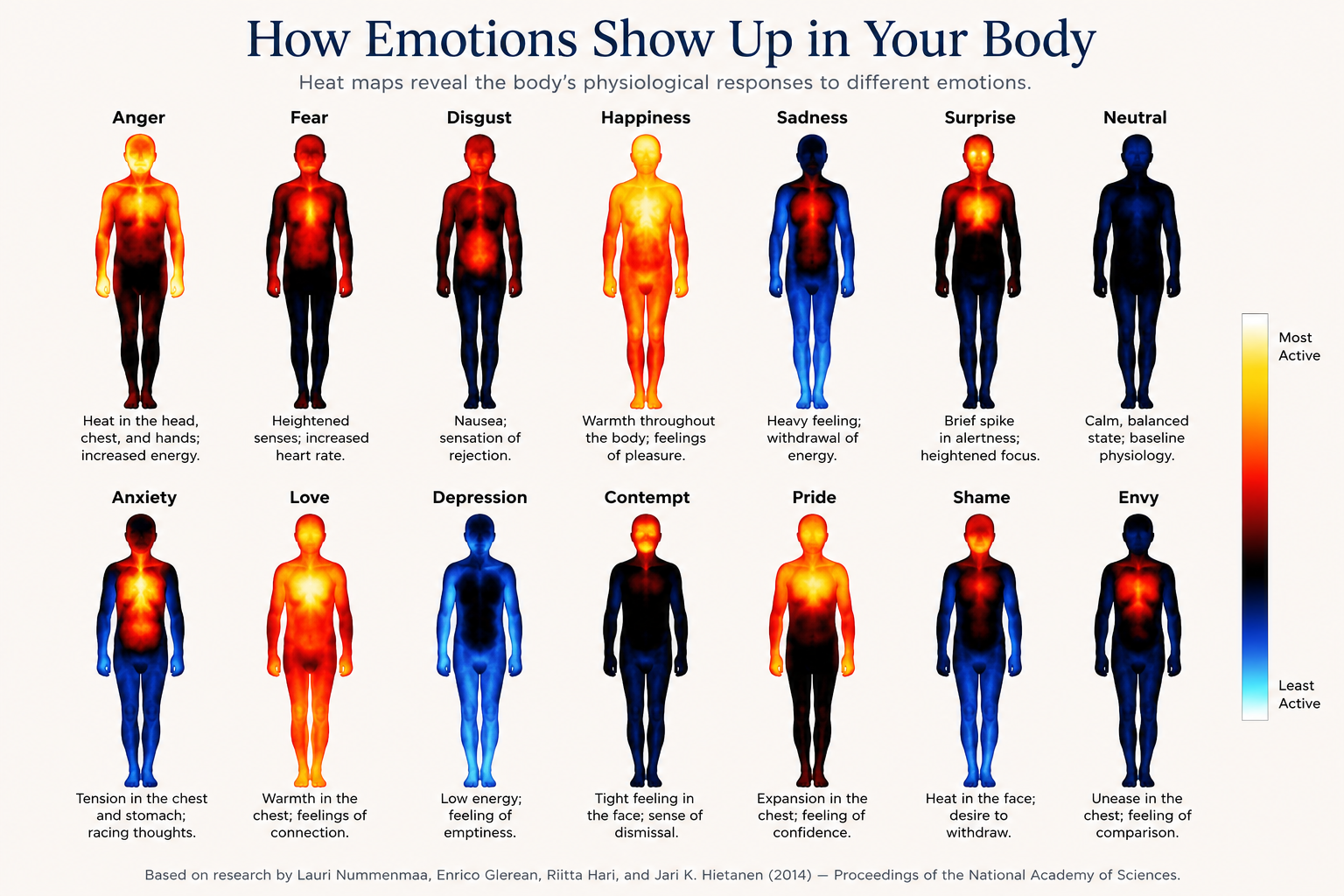
In a landmark 2014 study, Lauri Nummenmaa and colleagues asked participants from multiple countries to identify where they felt different emotions in their bodies. The results revealed remarkably consistent emotional 'body maps,' offering scientific support for something many of us already know intuitively: our bodies are often speaking long before our minds catch up.
Long before our minds construct a logical explanation, our bodies are gathering information.
Researchers studying decision-making, emotion, and perception have found that the body often registers signals before we consciously understand what is happening. Tiny shifts in heart rate, muscle tension, breathing patterns, and nervous system activation can occur moments before we are able to articulate a thought.
We've all experienced this. The knot in your stomach before receiving difficult news. The tension in your shoulders around someone who doesn't feel safe. The sense of expansion and ease when something feels aligned.
The body is constantly communicating. The challenge is that many of us have spent years learning to ignore those messages.
We override exhaustion and call it productivity.
We dismiss anxiety and call it overthinking.
We suppress discomfort because we don't want to disappoint others.
Over time, we become disconnected from our internal signals.
Rebuilding trust often begins by listening again. Not because the body is always right, but because it is always providing valuable information.
The Cost of Ignoring What We Know

When we ignore what we know, we lose our ability to see our way back to ourselves.
Have you ever known something and chosen to ignore it?
I have.
Particularly in relationships.
Years ago, I found myself overlooking an abundance of red flags. Looking back, I can see countless moments when my intuition attempted to get my attention.
And I ignored it. Repeatedly. The price I paid felt enormous at the time. And so did the lessons.
After the relationship ended, I spent nearly a year doing the difficult work of recovery and self-reflection. I asked myself hard questions.
Why had I chosen this relationship?
Why had I ignored my intuition?
Why had I abandoned myself?
As I searched for answers, I began learning about unhealthy relationship dynamics, attachment patterns, and the ways in which self-worth can become entangled with the need for acceptance and validation.
I also discovered something unexpected.
Often, when I couldn't clearly read the other person's energy or intentions, I interpreted that uncertainty as excitement.
What felt unfamiliar seemed intriguing.
What felt confusing appeared compelling.
In hindsight, I was sometimes mistaking impulse for intuition.
Recognizing that truth was painful.
I sat with it for a long time.
But eventually, another realization emerged.
If self-trust had been damaged, perhaps it could also be rebuilt.
Rebuilding Self-Trust
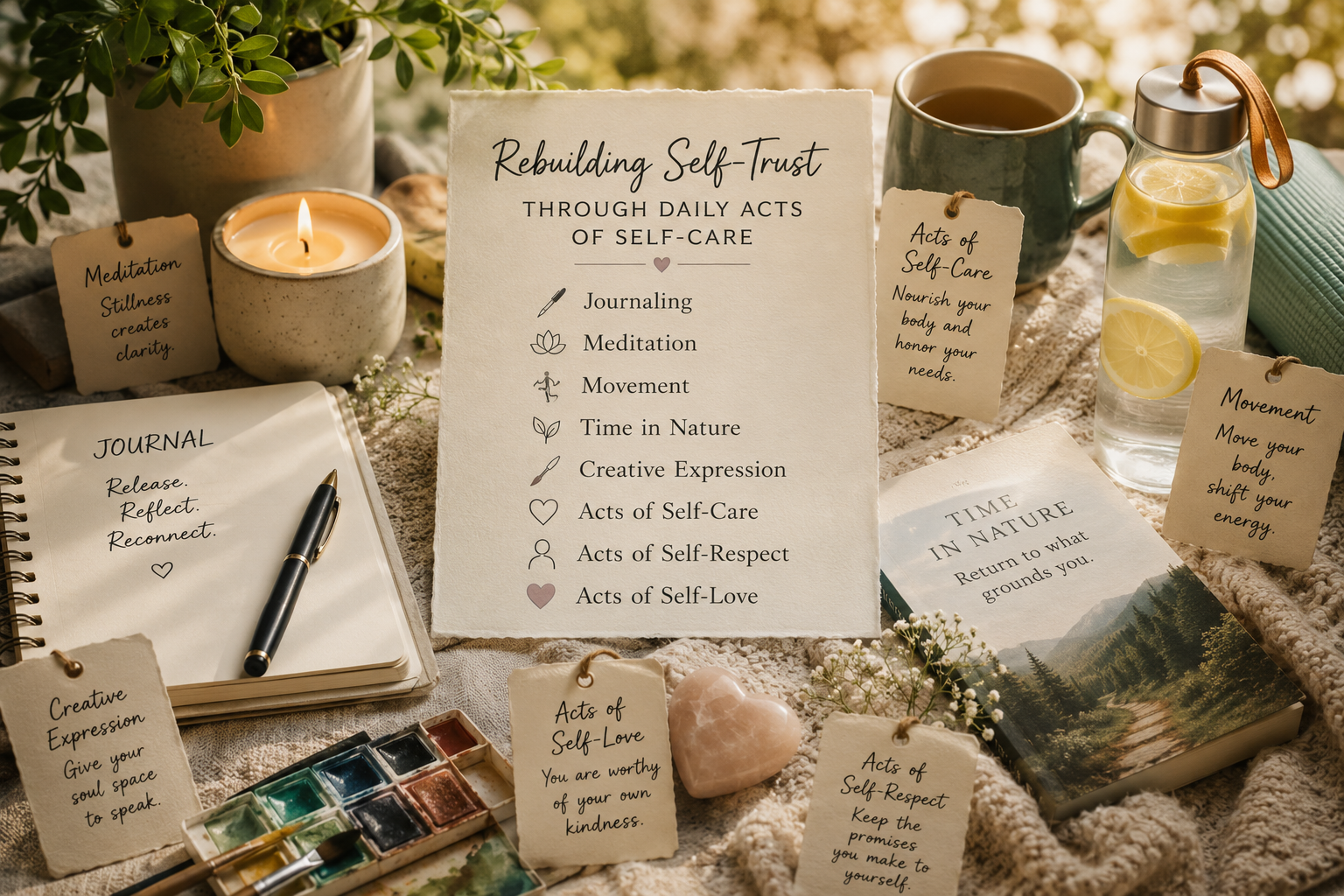
Self-trust is rebuilt not through grand promises, but through the quiet, daily acts of caring for ourselves, honoring our needs, and keeping the commitments we make to our own wellbeing.
Rebuilding self-trust didn't happen through a grand revelation. It happened through small acts. Daily acts.
For me, it began by connecting with other women who had walked similar paths. Women who were asking the same questions and searching for the same answers.
I listened.
I learned.
I healed.
Each day I returned to my top lines—the simple practices that nourished my wellbeing and kept me connected to myself.
At first, these practices felt small. Journaling. Meditation. Movement. Time in nature. Time alone. Creative expression. Acts of self-care. Acts of self-respect. Acts of self-love. Over time, they became the foundation upon which I rebuilt my life.
Gradually, my decision-making changed. My boundaries strengthened. Situations that once would have led me toward self-abandonment became easier to recognize and decline. Most importantly, I developed confidence that I would not forsake myself in pursuit of love, acceptance, validation or approval.
The relationship I was rebuilding wasn't with another person. It was with myself. And that relationship changed everything.
Self-Care Is Not Selfish
There is one final piece of this conversation that feels important.
Our culture often celebrates self-sacrifice. We are encouraged to give more. Do more. Care for everyone else first. Women, in particular, are often conditioned to place the needs of others ahead of their own.
While generosity and service are beautiful qualities, they become problematic when they require us to abandon ourselves.
Because eventually, depletion catches up with us. Resentment grows. Burnout follows. And the people we care about receive a version of us that is exhausted rather than nourished.
The truth is that self-care is not selfish. It is stewardship.
When we care for ourselves, we show up more fully for the people we love.
When we trust ourselves, we make healthier decisions.
When we honor our own needs, we create relationships built on authenticity rather than obligation.
Self-trust and self-care are not luxuries. They are foundations. And they may be among the greatest gifts we can offer both ourselves and those we hold dear.
Reflection
Where in your life do you already know the answer?
What have you been second-guessing?
What signals has your body been trying to communicate?
What would change if you trusted yourself just a little more?
And what small act of self-trust could you practice today?
-Dani Keating
Heath and Life Coach
Coaching with Dani