
Decluttering Our Spaces
Decluttering isn't about creating empty space—it's about creating room for what matters most.
Over the past two days, we've explored ways to nourish ourselves and declutter the mind through meditation. Today, I'd like to shift our attention outward—to the spaces that surround us.
Our external environments often serve as a reflection of our internal landscapes. When life feels chaotic, our homes, workspaces, and schedules can begin to mirror that experience. At other times, the clutter in our surroundings may contribute to feelings of overwhelm, distraction, or stagnation.
The good news is that decluttering doesn't always have to begin within.
Sometimes clearing a countertop, organizing a closet, or making a bed is the safest and most energizing place to start.
The Ancient Tradition of
Spring Cleaning
The impulse to clear our spaces during spring is not a modern invention.
Across many cultures, spring has long been associated with renewal, purification, and preparation for a season of growth. In Celtic traditions, Beltane (May 1st) marked the transition into the lighter half of the year. Homes were swept, hearths were cleaned, and communities prepared themselves physically and spiritually for the abundance of the months ahead.
Practical considerations certainly played a role. After a long winter spent largely indoors, homes accumulated dust, soot, and the remnants of colder months. Yet the act of cleaning was often more than practical. It symbolized making room for what was to come.
In many ways, we continue this tradition today. We may not be sweeping out a winter hearth, but we still feel the urge to open windows, sort through closets, donate unused possessions, and create a little more breathing room in our lives.
Spring invites us to ask a simple question: What am I ready to release so that something new may emerge?
Where Do I Begin?

Overwhelm often isn't caused by the size of the task ahead—it comes from not knowing where to begin.
For many people, the hardest part of decluttering is getting started.
Even the most committed minimalist accumulates belongings over time. Life happens. Papers pile up. Closets become crowded. Projects remain unfinished. Before long, the task can feel overwhelming.
The decision to declutter is the first step.
The second is choosing an approach that feels manageable.
You might set a timer for five or ten minutes and focus on a single drawer, shelf, or corner of a room.
You might choose one highly visible area—a kitchen counter, bedside table, or workspace—and commit to maintaining only that space for a week.
Another approach is to notice where you feel the greatest resistance. Is there a room, closet, or pile you've been avoiding? Rather than immediately tackling it, spend a few minutes simply sitting with the discomfort it evokes. Then shift your attention to an area that feels easier and begin there.
Momentum often matters more than intensity.
Small acts performed consistently tend to create greater change than occasional bursts of effort.
The Benefits of Organization
Decluttering is not simply about creating a visually pleasing environment. It is fundamentally about directing our energy. Every object we own requires some degree of attention. We clean it, move it, store it, repair it, organize it, or think about it. When our environments become crowded, our attention becomes fragmented.
Many of us have experienced the frustration of searching for lost keys, a wallet, an important document, or a phone charger. These moments may seem insignificant, but they add up. They consume time, create stress, and drain energy that could be directed elsewhere.
A thoughtful system of organization helps reduce this hidden energy expenditure. Instead of constantly managing our belongings, we free ourselves to focus on what matters most—our relationships, creativity, work, health, and wellbeing.
Organization is not about perfection.nIt is about creating enough structure that life flows with a little more ease.
The Challenge of Letting Go
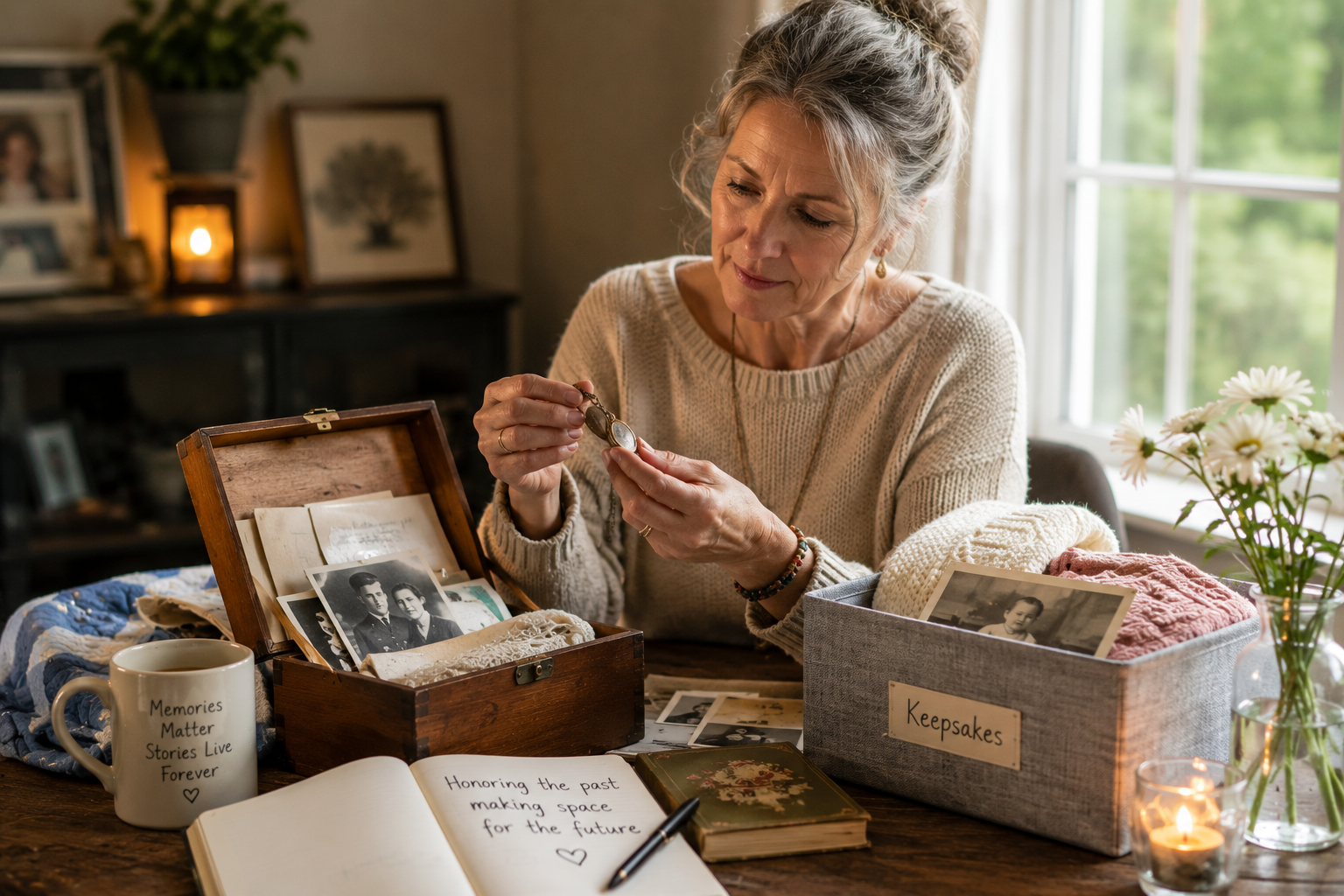
Sometimes the most meaningful act of decluttering is honoring the memories we cherish while making room for the life that is still unfolding.
Often, the most difficult aspect of decluttering is not deciding what to keep.
It is deciding what to release.
Many possessions carry memories, identities, hopes, and stories. A box of letters may remind us of a relationship. A piece of clothing may connect us to a former version of ourselves. An inherited object may carry the memory of someone we loved.
Sometimes what we're struggling to let go of is not the object itself. It's the meaning we've attached to it. This is where compassion becomes important.
You do not have to force yourself to release something before you're ready.
You might begin by simply asking:
What does this object represent?
What memory am I afraid of losing?
Is the memory contained in the object—or does it live within me?
Does this item support the life I am living today?
There are many ways to honor what an item represents without keeping every physical object associated with it.
Photographs, journals, memory boxes, and intentional rituals of gratitude can help us preserve meaning while creating space for what comes next.
Asking for Help

Sometimes the greatest gift a friend can offer is not helping us organize our belongings, but helping us see the possibilities waiting on the other side of letting go.
Decluttering does not have to be a solitary endeavor. Sometimes inviting a trusted friend into the process provides accountability, encouragement, and perspective.
Others find support through working with a coach or professional organizer. These individuals can help create systems, reduce overwhelm, and provide structure when the task feels too large to tackle alone.
In situations involving chronic disorganization, compulsive acquiring, or hoarding behaviors, additional support may be needed. Hoarding often has deep emotional and psychological roots, and working with a psychologist who specializes in hoarding can provide compassionate and effective guidance.
There is strength in asking for help.
Sometimes another person can see possibilities that remain hidden when we're standing too close to the challenge.
What Happens When We Let Go?
One of the most surprising aspects of decluttering is that the process is rarely about creating emptiness.
Instead, it creates possibility.
When we release what no longer serves us, we create room for new experiences, relationships, opportunities, and ways of being. Nature demonstrates this principle constantly.
Trees release leaves.
Gardens are thinned.
Seeds break open.
Growth often requires space.
The same is true in our homes and in our lives.
Creating Sacred Space

I set out to create a garden, but what I truly cultivated was a deeper sense of home, belonging, and connection.
For me, decluttering is not simply about organization. It is about creating spaces that nurture wellbeing. I've always been someone for whom place matters deeply.
Where I live, the surrounding landscape, access to nature, the culture of a community, and the people around me all influence my wellbeing. Having lived in many regions of the country, I've found that some places support me more fully than others. Access to organic food, outdoor recreation, diverse communities, and opportunities for connection all contribute to my sense of belonging.
Yet perhaps most important is the environment I create within my own home.
I've rented rooms from friends. I've lived in an Oxford House. I've lived in apartments, condos, and now a single-family home.
In every setting, creating a nurturing space has been essential.
Recently, I've begun expanding the concept of sacred space beyond the walls of my home and into the landscape itself.
This spring I created a Japanese garden in my front yard. In many ways, it reconnects me to my childhood in the San Francisco Bay Area, where Japanese gardens and cultural influences were woven into the fabric of daily life. Bringing that element into my home here in Del Ray has helped this place feel a little more like home.
What surprised me most was how the project affected my relationship with the community.
Neighbors stopped to chat. People offered compliments and encouragement. One person even asked if I would help create a similar garden in their own yard.
What began as a personal project unexpectedly became a bridge to connection.
It also changed how I move through my neighborhood. I've become more aware of the care, creativity, and attention that others bring to their own spaces. I notice gardens, flowers, front porches, and small acts of stewardship that previously escaped my attention.
In creating a sacred space, I discovered something larger.
I wasn't just cultivating a garden.
I was cultivating belonging.
Final Thoughts
Decluttering is rarely about getting rid of things.
At its heart, it is about creating room for what matters most.
Whether you begin with a single drawer, a cluttered countertop, a closet, or an entire room, the invitation remains the same:
Release what no longer serves.
Create space for what does.
And remember that every object removed creates an opportunity for something else to flourish.
-Dani Keating
Health and Life Coach
Coaching with Dani