
Meditation and Decluttering the Mind

Long before I knew the word meditation, I learned to quiet my mind on a swing beneath a tree, carried by sunlight, birdsong, and wonder.
Every afternoon as a young child, without fail, I could be found on the swing in the backyard.
Sun and breeze upon my face.
Birds singing.
My mind still. Focused. Experiencing awe.
Sometimes I made up songs to sing.
Other times my mind wandered.
This occurred for hours, every day, all year round.
Stilling my mind. Intentionally mind wandering. Feeling into every moment.
I didn't have the words to describe what I was doing until I was much older.
When I say I've been meditating for fifty years, I'm counting all those hours swinging and meaning it.
Meditation Alters the Mind
When we still our minds, amazing things happen.
And it's only been the past few decades that science has begun to understand what many cultures have known for thousands of years: meditation is medicine for the mind, body, and spirit.
One of the most fascinating discoveries is that meditation changes the structure and function of the brain through a process known as neuroplasticity—the brain's ability to adapt and reorganize itself throughout our lives.
Research suggests that regular meditation strengthens areas of the brain associated with attention, emotional regulation, memory, learning, and self-awareness. At the same time, it appears to reduce activity in regions associated with fear, stress, rumination, and the constant mental chatter that so often dominates modern life.
Meditation also influences the nervous system. By slowing down and focusing our attention, we activate the parasympathetic nervous system—the body's natural rest, digest, and repair mode. Heart rate slows. Muscles soften. Breathing deepens. The body receives a signal that it is safe.
What this ultimately means is that meditation helps us cultivate the ability to focus, see more clearly, respond rather than react, and navigate life's challenges with greater ease and resilience.
While many of these benefits are now widely known, what I find interesting is how much emotion and mythology surrounds the practice itself.
Many people believe meditation must be done in a particular position, for a particular length of time, in complete silence, with a completely empty mind.
None of that is true. Meditation is not about eliminating thought. It is about noticing where your attention is and gently bringing it back when it wanders.
That is the practice.
Starting Small
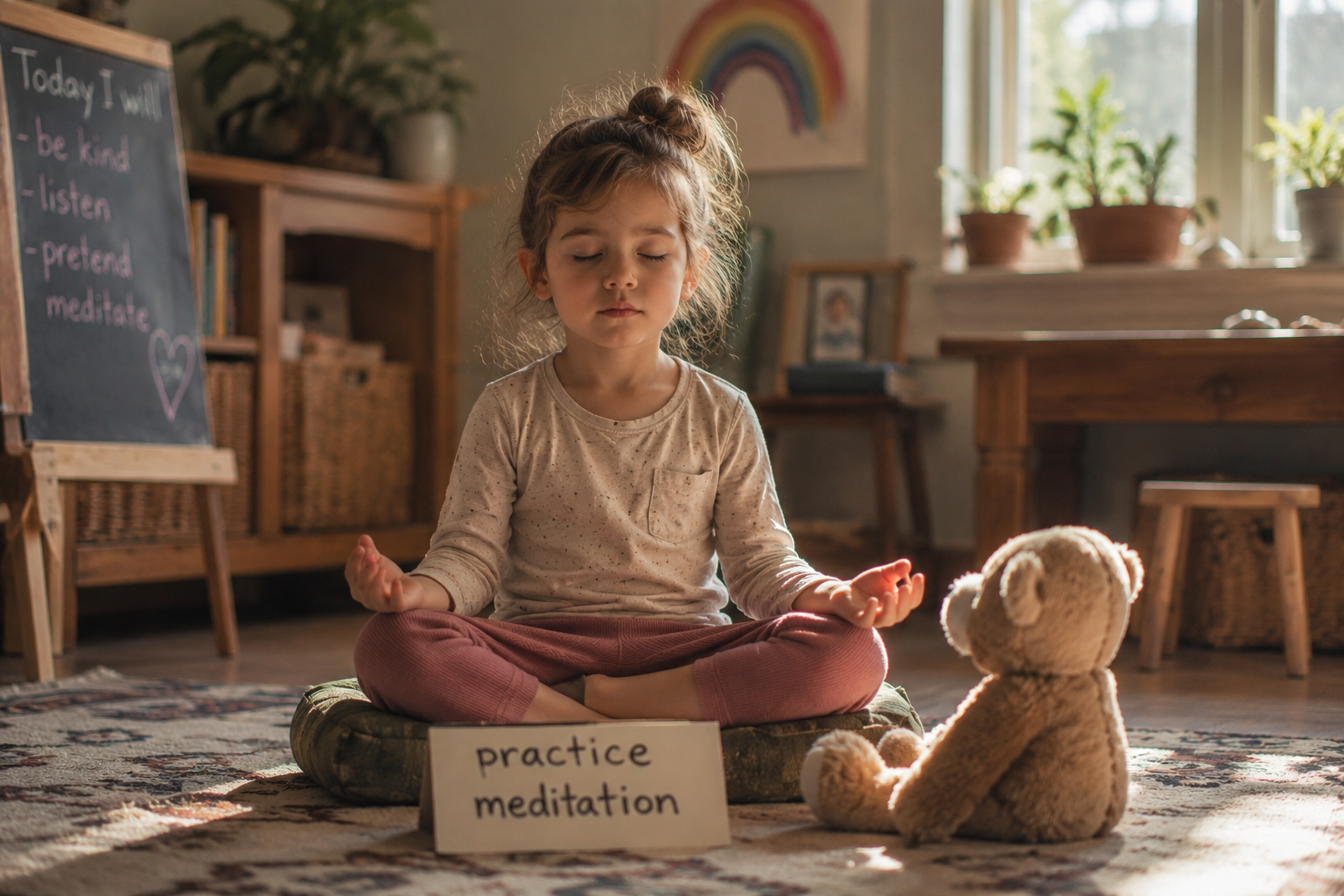
Wonder, curiosity, and imagination are often the first steps on the path to stillness.
And I mean small. Perhaps even with a child's mind. One of my favorite approaches for beginners is what I call "pretend meditating."
Shift your attention and your body into whatever you imagine meditation to be.
Sit quietly.
Close your eyes.
Take a few slow breaths.
Listen carefully.
Children do this naturally. They can pretend almost anything. And spoiler alert—when you're pretending to meditate, you're actually learning to meditate.
For those who have never meditated before, I often recommend starting with a guided meditation.
The act of listening to another person's voice is meditation. When your attention wanders—which it inevitably will—you simply bring it back to the voice.
That's it.
You've done it.
The more you practice, the longer your attention tends to stay anchored.
You might focus on a voice.
Your breath.
A candle flame.
The sound of rain.
The rhythm of your footsteps.
The sensation of washing dishes.
You can meditate sitting down, lying down, standing up, walking, running, gardening, knitting, or swinging on a backyard swing.
The form matters far less than the quality of attention you bring to the moment.
Benefits of Meditation
According to Dr. Amishi Jha, professor of psychology at the University of Miami, as little as 12 minutes a day can begin producing measurable benefits.
That's good news for those of us who think we don't have enough time.
Research suggests that regular meditation may:
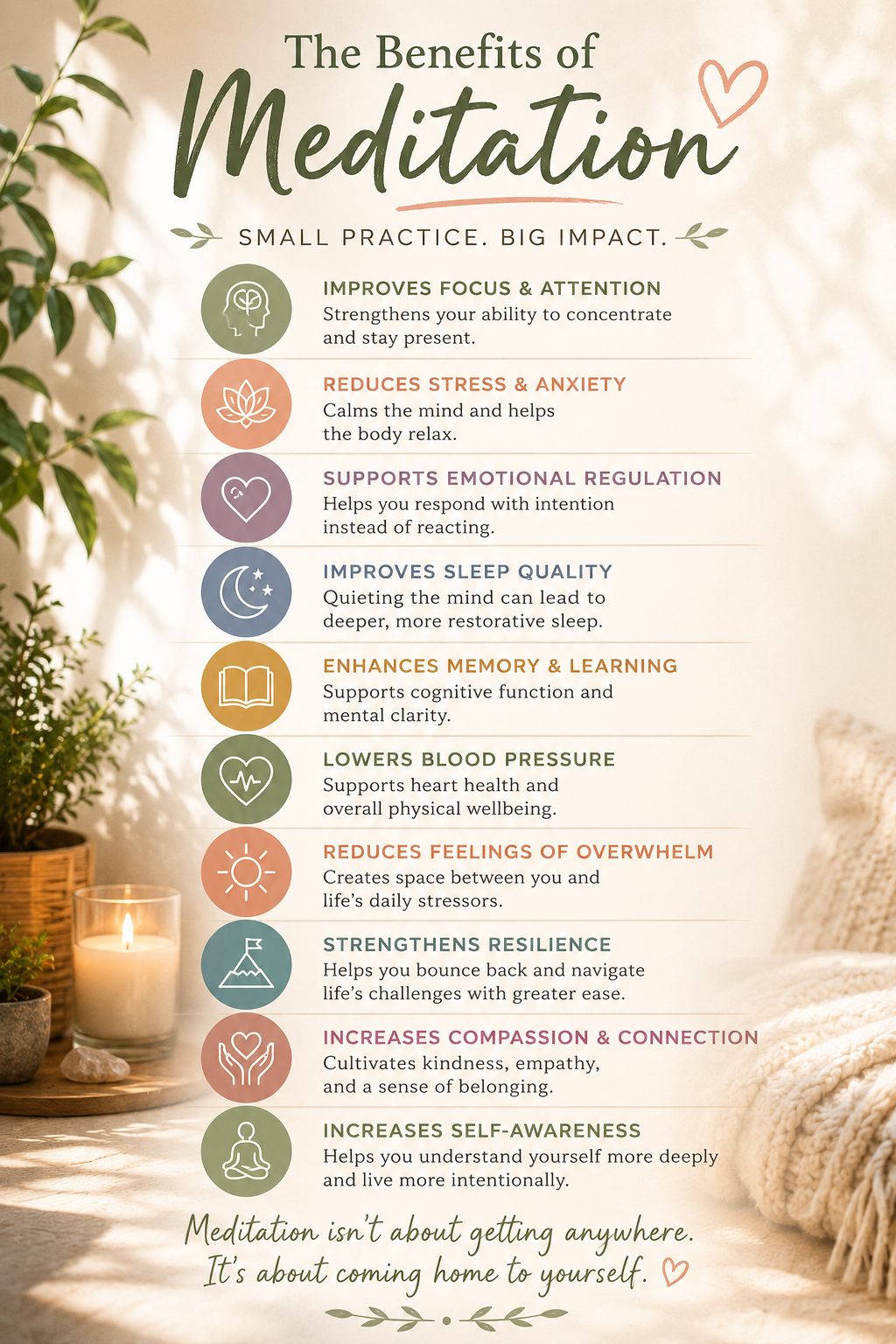
Improve focus and attention
Reduce stress and anxiety
Support emotional regulation
Improve sleep quality
Increase self-awareness
Enhance memory and learning
Lower blood pressure
Strengthen resilience during difficult times
Increase feelings of compassion and connection
Improve overall wellbeing
Those are impressive outcomes.
But what I appreciate most about meditation isn't any particular benefit. It's the relationship it helps us cultivate with ourselves.
Meditation teaches us to pause.
To notice.
To become curious.
To witness our thoughts without immediately believing them.
To create a little space between what we experience and how we respond.
In a world designed to capture and monetize our attention, reclaiming even a few moments of awareness each day feels quietly revolutionary.
A Few Words About Aphantasia
I, like many others, have aphantasia—a neurological phenomenon in which the mind's eye does not generate visual imagery.
When guided meditations invite participants to imagine a beach, a forest, or a glowing light, many people can actually see those things in their minds.
I cannot.
My internal screen is mostly blank.
I discovered this only a few years ago when I began asking others about their experiences during visualization exercises. I was stunned to learn that many people can create incredibly vivid mental images.
When I fall into deep meditation, I often experience colors, patterns, sensations, and shifts in awareness, but very little visual imagery.
And that's perfectly okay.
Meditation is not a visualization contest.
Some people experience images.
Others experience feelings.
Others notice sounds, physical sensations, emotions, or simply a deep sense of presence.
If you struggle to visualize, don't worry. Lean into the sensory experiences available to you. There are many pathways into meditation, and none are more correct than another.
Sleep, Rest, and Meditation
There is also much to say about meditation's relationship with sleep, which is a topic worthy of its own article.
On the rare occasions when I struggle to fall asleep, I often turn to shamanic drumming, soft music, or a guided meditation.
Some of you may also be familiar with Yoga Nidra, a practice sometimes called "yogic sleep." It can be a wonderful way to rest, recharge, and calm an overactive mind.
More often, however, I meditate first thing in the morning.
Before coffee.
Before email.
Before the world begins asking anything of me.
I like to honor the day by tending to my mind and setting intentions for the hours ahead.
A Simple Practice
If you're curious, I invite you to try this simple two-minute meditation.
Find a posture that feels comfortable.
Feel the earth beneath you supporting the weight of your body.
Soften your gaze or gently close your eyes.
Bring your attention to your breath.
Breathe slowly, deepening each inhale.
Release a little more completely with each exhale.
After five or so breaths, allow your breathing to return to its natural rhythm.
Then repeat the following mantra:
With each inhale: "I am doing my best."
With each exhale: "Let go of the rest."
Repeat this five times.
Then release the mantra and return your attention to your breath.
When you feel ready, invite in some gentle movement.
Open your eyes if they are closed.
Return to your day.
And remember, this practice is always available to you.
A few breaths.
A moment of awareness.
A return to yourself.
Sometimes that is all it takes.
If you're interested in exploring meditation further, I invite you to visit the meditation page on my website, where you'll find several guided meditations available free of charge. You might also explore apps such as Calm or Insight Timer, both of which offer excellent guided practices for beginners and experienced meditators alike.
Remember, there is no wrong way to meditate.
Find what works for you.
And if you can, spend a little time journaling about your experiences. You may discover that the greatest benefits appear not in a single meditation session, but in the subtle ways your relationship with yourself changes over time.
-Dani Keating
Health & Life Coach
Coaching with Dani