
In Search of Awe
Why Wonder Might Be One of the Most Important Practices We’ve Forgotten
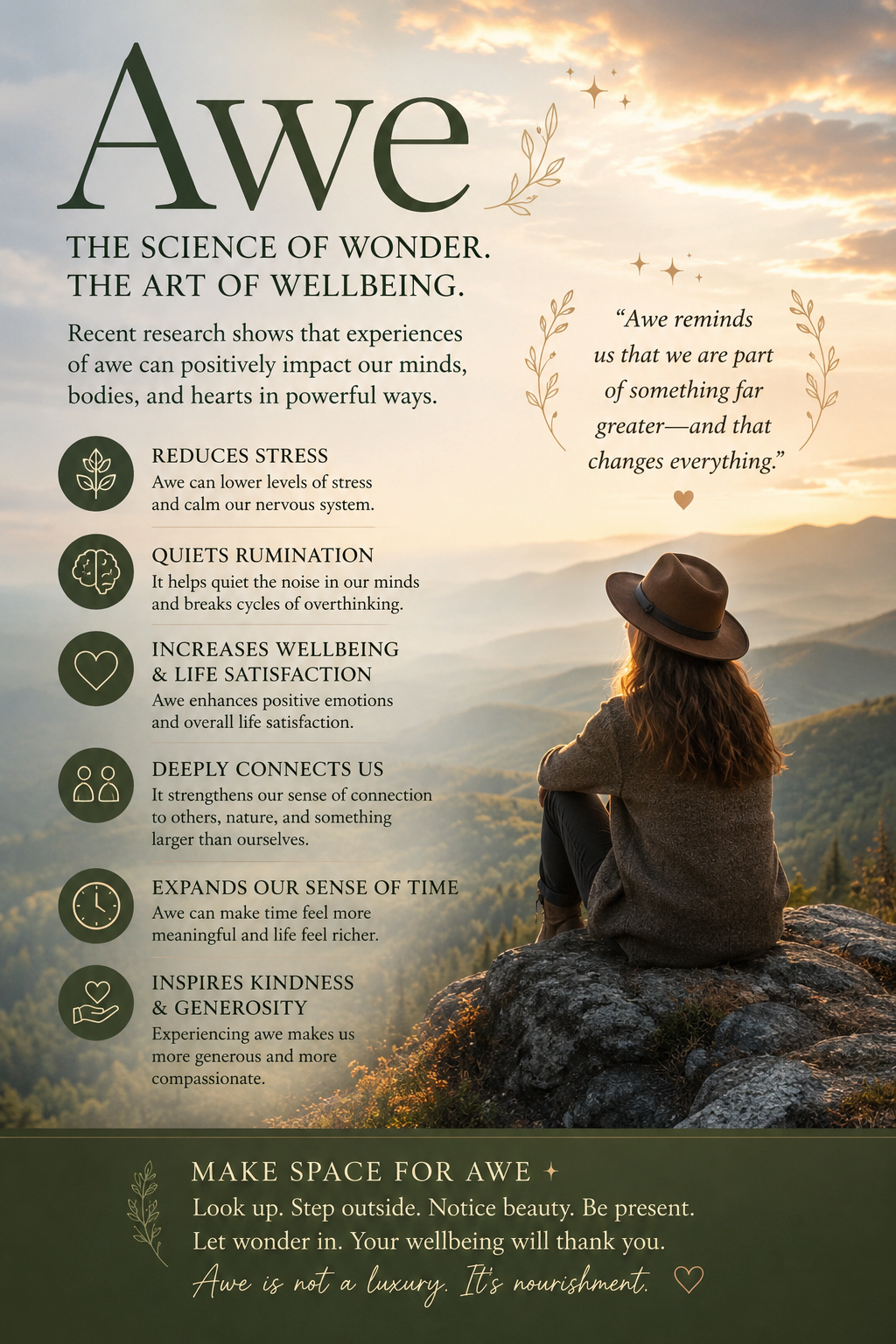
Awe is not an escape from life—it is a return to wonder, connection, and the quiet remembering that we belong to something larger than ourselves.
Over the past several weeks, I’ve found myself returning to a question that feels deceptively simple:
What actually helps us feel alive?
Not productive. Not entertained. Not optimized.
Alive.
The question emerged gradually through the themes I’ve been exploring lately—journaling as a practice of listening inward, rest as an act of restoration rather than laziness, and nature as an original teacher that offers wisdom through relationship rather than instruction.
As I reflected on these ideas, another word kept coming to mind.
Awe.
And perhaps unexpectedly, science has started paying attention too.
Recent research suggests that experiences of awe may support wellbeing in meaningful ways. Studies indicate that awe can help reduce stress, soften rumination, increase feelings of connection and generosity, expand our perception of time, and invite a greater sense of meaning and belonging. Scientists have even proposed that awe helps shift us out of excessive self-focus and into relationship with something larger than ourselves.
Which sounds remarkably familiar.
Because long before researchers began measuring it, people sought awe intentionally through pilgrimage, ceremony, storytelling, wilderness, music, art, prayer, and gathering around fires.
Perhaps we have always known we need it.
My Relationship with Awe

Some places remind us that awe is not something we chase—it is something we remember when we finally become still enough to look up.
When I look back across my life, awe has been one of the most consistent threads.
I felt it while walking the Camino de Santiago years ago.
There is something difficult to describe about walking long distances across landscapes that have carried millions of footsteps before your own. Day after day, your world becomes simpler. You wake. You walk. You eat. You rest. The noise begins to settle. Somewhere between exhaustion and repetition, ordinary things start becoming extraordinary again.
I found awe living in Oregon as well.
The landscapes there felt impossibly large to me at times—mountains emerging from mist, forests that seemed ancient beyond language, coastlines that reminded me how small and temporary human concerns can be.
Travel has given me glimpses of awe too. New places expand our understanding of what life can look like and quietly challenge assumptions we didn’t even realize we were carrying.
But lately, if I’m honest, awe has become smaller.
And perhaps more meaningful.
I find it camping in the Airstream. Morning coffee outside on the front porch. Watching storms move in. Listening to birds before anyone else wakes up. Building a fire. Stargazing.
Those moments don’t solve anything. My retirement still needs designing. Bills still arrive. The world still feels uncertain. But awe does something else.
It restores proportion.
It reminds me that life is not a problem to solve.
It is an experience to participate in.
Why Awe Feels So Difficult Right Now
I sometimes wonder whether our modern way of living unintentionally crowds awe out.
We spend more time indoors than previous generations. We consume more information than our nervous systems evolved to process. We move quickly. We fill empty space. We document experiences before fully inhabiting them.
We optimize our days but rarely allow ourselves to be surprised by them.
And slowly, often without realizing it, our world becomes smaller. Not physically. But emotionally. Spiritually. Experientially.
This may be one reason why experiences of awe matter so much. Awe interrupts certainty.
It slows us down. It reminds us that not everything needs to be controlled, measured, improved, or understood. Some things simply need to be witnessed.
A Simple Practice for Cultivating Awe

Awe rarely arrives as a grand event—it gathers quietly in ordinary moments, waiting for us to slow down enough to notice.
As I reflected on awe, I realized it may quietly tie together everything I’ve been writing about recently.
Journaling teaches us to pay attention. Rest gives us enough spaciousness to notice. Nature creates the conditions where awe often appears. Together, they form something that feels less like a productivity system and more like a way of being.
A practice of becoming available to life.
Not forcing insight.
Not manufacturing meaning.
But creating conditions where meaning can emerge.
To close this week, I want to offer an experiment. For one week, create a small ritual around awe. Choose a moment each day to seek something that feels larger than yourself. This does not require airfare, mountains, or dramatic adventures.
The goal is not intensity.
The goal is attention.
Afterward, spend five minutes reflecting. Ask yourself:
What did I notice?
How did my body feel?
What felt different afterward?
What seemed less important?
What seemed more important?
Then journal.
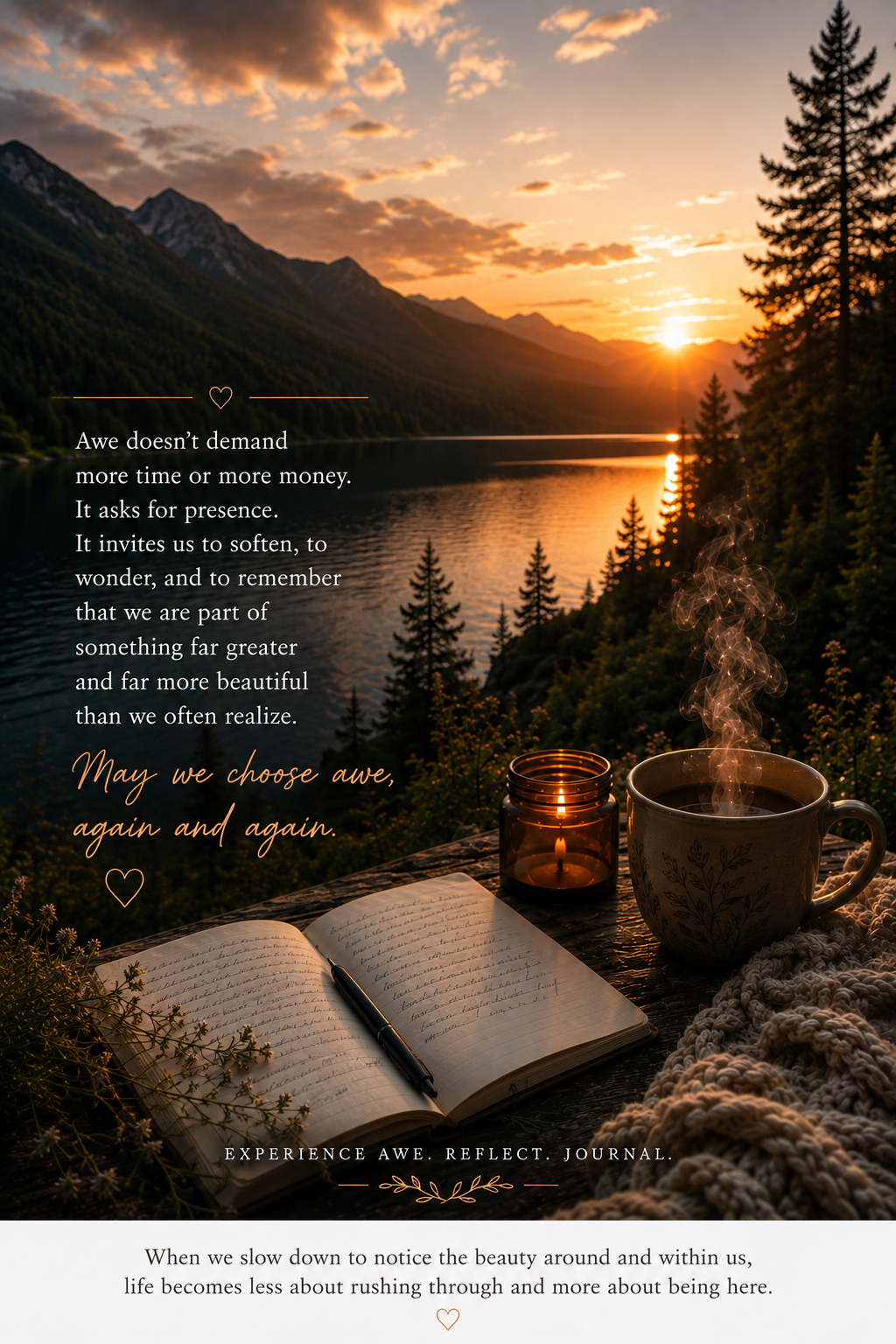
Awe does not ask us to become more—it simply invites us to become present enough to remember that this life, exactly as it is, still contains wonder.
Not to produce insight. Not to write beautifully. Simply to capture the experience while it is still warm. Treat awe like something worth remembering. Over time, you may begin to notice patterns.
Certain places.
Certain rhythms.
Certain ways of being.
You may discover that awe is not rare at all. You may discover that what has been rare is your availability to it.
Final Thoughts
I wonder sometimes if one of the quiet tragedies of modern life is not that we have lost meaning. It is that we have forgotten to make room for wonder. Because awe asks very little from us.
Only attention. Presence. Enough slowness to look up.
And perhaps that is the invitation.
Not to chase extraordinary experiences.
But to become the kind of people who notice them.
This week, I invite you to go find one moment of awe every day.
Experience it.
Reflect on it.
Write about it.
And see what changes.
-Dani Keating
Health & Life Coach