
MIND: Guard Your Attention
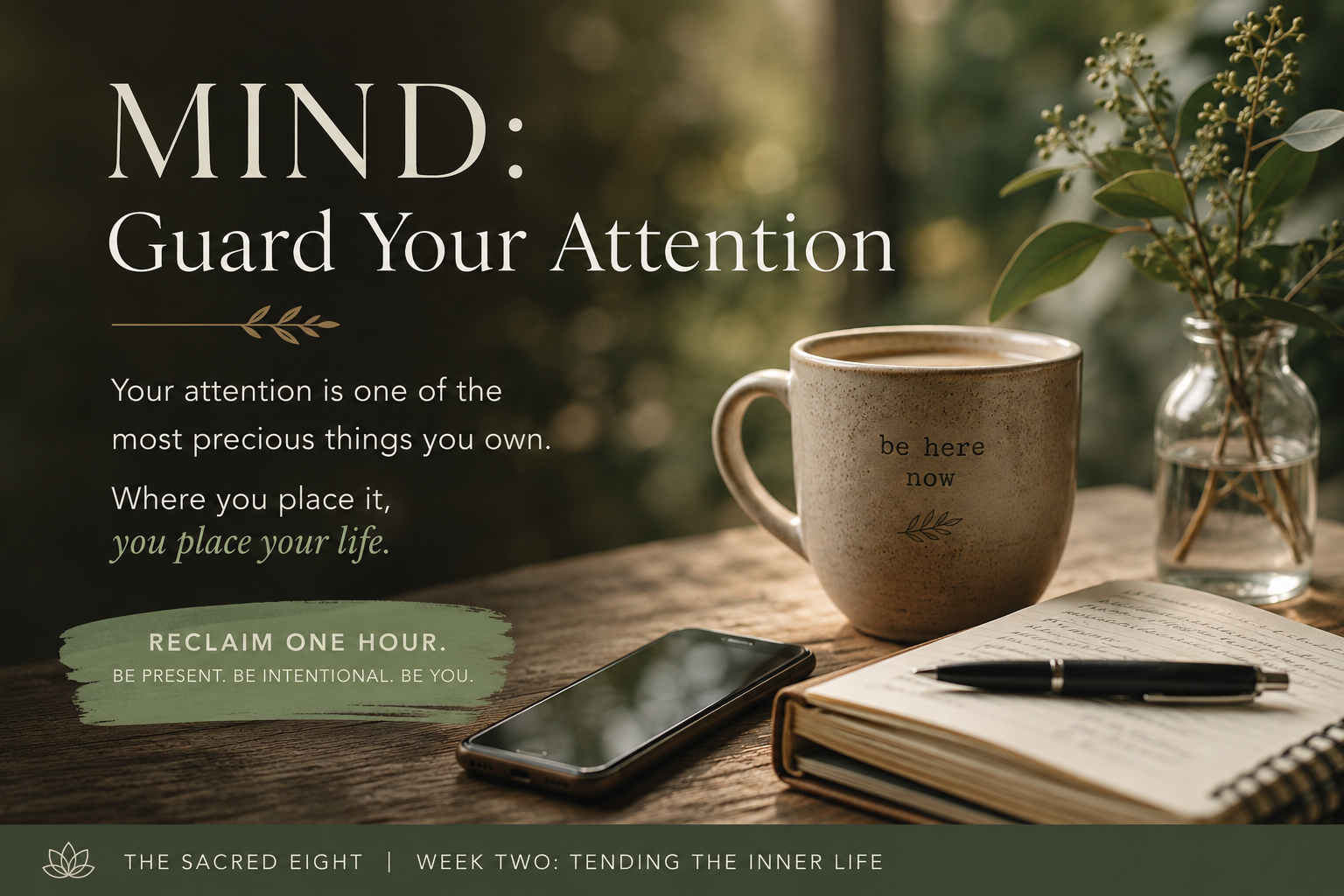
Last week, we began The Sacred Eight: Eight Practices of Self-Care with Week One: Tending the Vessel.
We explored some of the foundational ways we care for ourselves: listening to the body, allowing ourselves to rest, paying attention to what nourishes us, and creating boundaries around our time and energy.
These practices aren't indulgences. They create capacity. When we are exhausted, depleted, overextended, or constantly saying yes when we mean no, there isn't much room left for anything else. We spend our days responding, reacting, managing and getting through.
But once we begin protecting a little space for ourselves, another question emerges: What are we going to do with it?
This week, we begin Week Two: Tending the Inner Life. We're moving a little deeper now, into the quieter territory of mind, meaning, connection and spirit. Because self-care isn't only about keeping ourselves functioning. It's also about tending the parts of us that make being alive meaningful.
And we're beginning with something that has become increasingly difficult to protect: our attention.
Everybody Wants a Piece of Your Brain
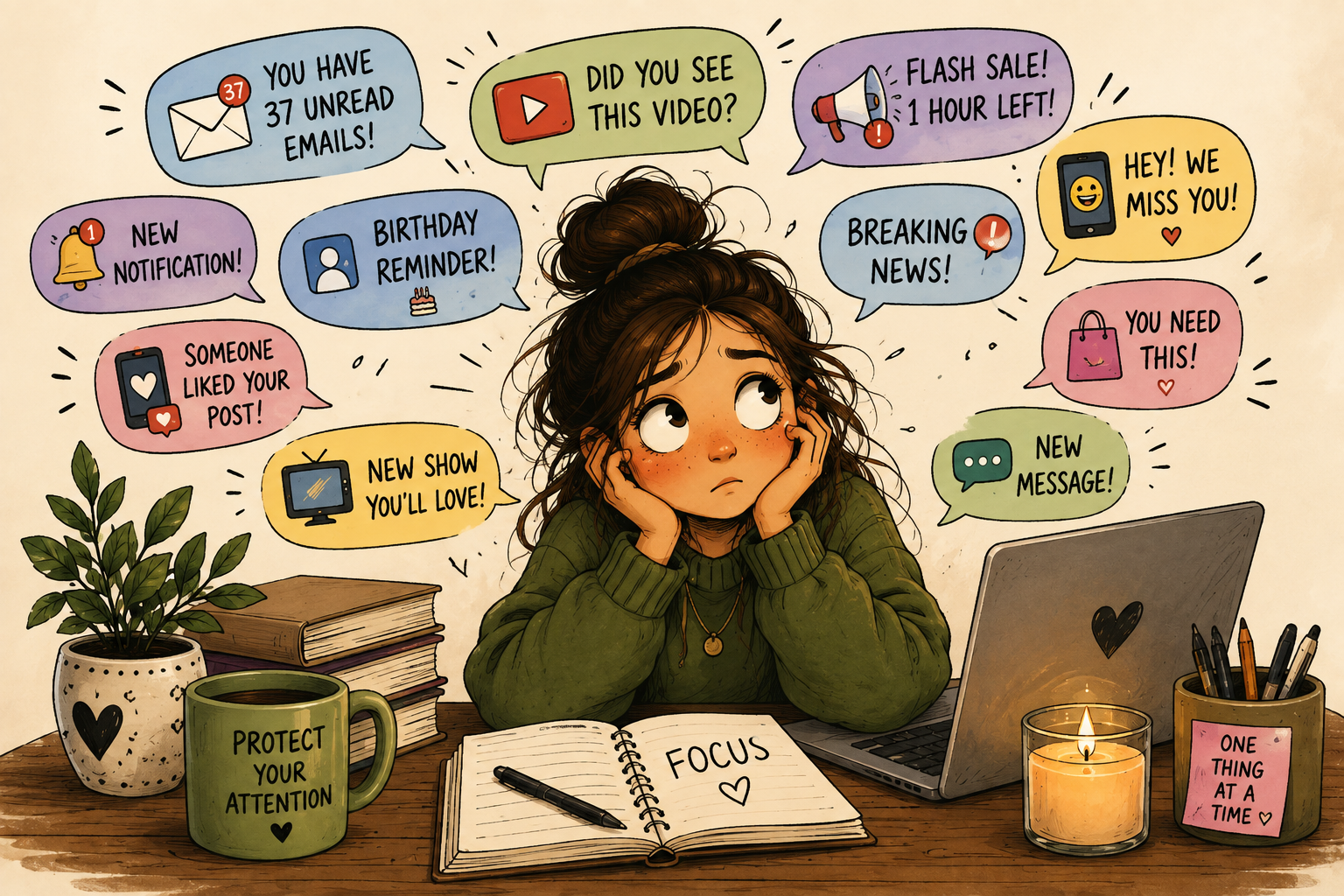
Notifications. Headlines. Emails. Algorithms. Advertising. Podcasts. Texts. Breaking news. Someone liked your post. Someone commented on your photo. Someone sent you a reel. Someone you haven't spoken to since high school is having a birthday.
Your inbox has 37 unread messages. And that's just in the last 24 hours. Your phone would like you to know that a celebrity you've never met has done something you probably don't care about.
Meanwhile, a streaming service thinks you'll love a new show, a retailer would like you to know there's only ONE HOUR LEFT! in a sale that will mysteriously begin again tomorrow, and an app you haven't opened in six months suddenly misses you terribly.
Everybody wants a piece of your brain. (Including me if we’re being honest, right?)
There is a reason for that. Attention has become a commodity. Entire industries are built around capturing it, holding it and redirecting it. The longer we look, click, scroll, watch or listen, the more valuable our attention becomes.
So everything gets louder, more urgent, more dramatic, more personalized and more difficult to ignore.
And somewhere inside all that noise is something much quieter: you. Your own thoughts. Your curiosity. Your creativity. Your ability to notice what is happening around you. Even boredom—that strange, uncomfortable little doorway through which imagination used to wander before we could reach for a phone.
When every empty moment is filled with incoming information, we rarely get the chance to hear what our own minds have to say.
Attention Is Life
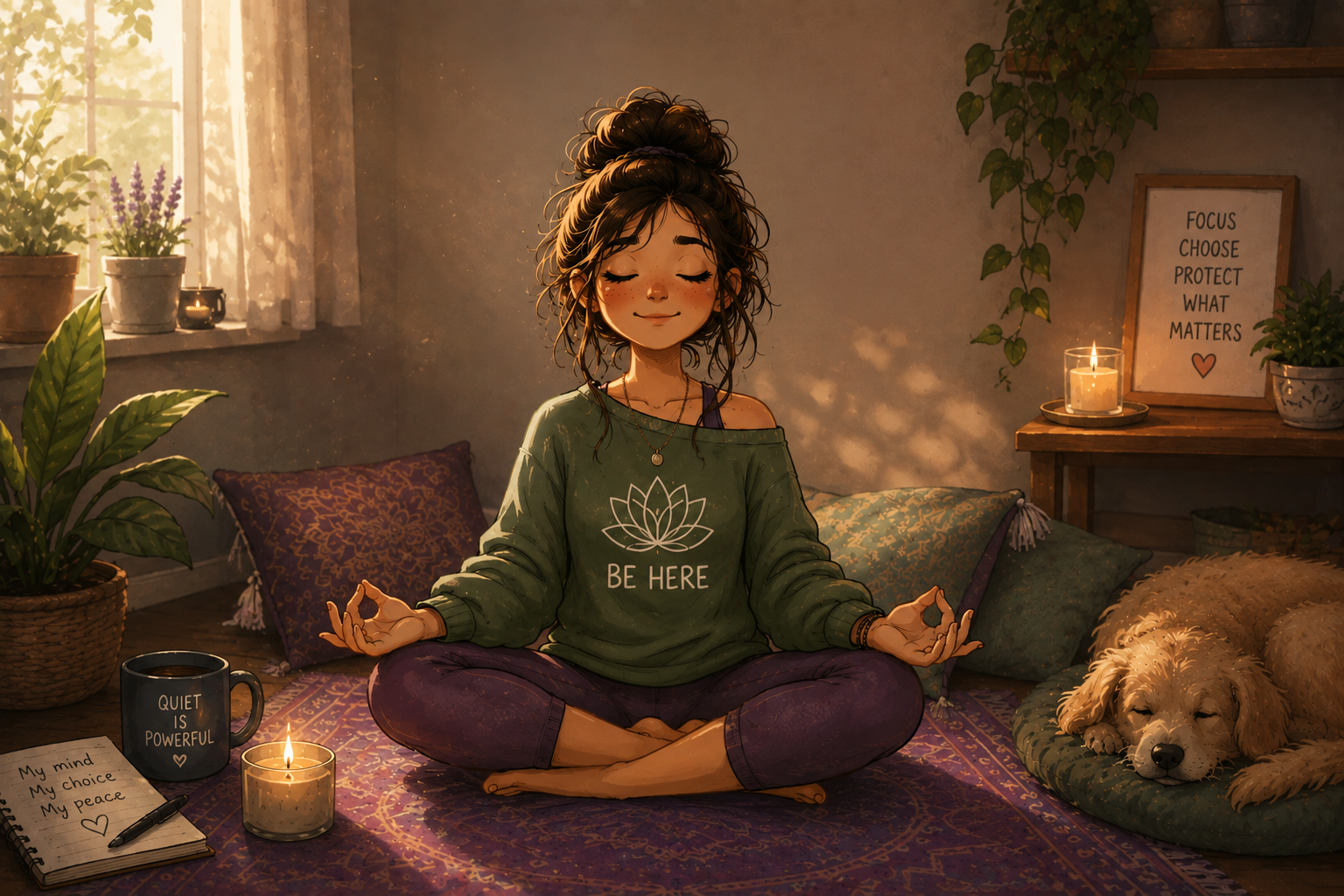
Where we repeatedly place our attention becomes, in a very real sense, where we spend our lives.
Our lives aren't only measured in years. They're measured in Tuesday mornings, ten-minute waits, walks around the neighborhood, conversations over dinner, quiet cups of coffee and afternoons in the garden. They're measured in hours spent reading, creating, worrying, scrolling, laughing, arguing, comparing and noticing.
Attention is how we experience all of it.
Which means self-care also includes deciding what deserves access to our minds. Not everything does.
Mindfulness is often associated with meditation, but at its heart, mindfulness is simply about paying attention to what is here. And increasingly, what is here is competing with what is on the screen.
We scroll while watching television, check messages while talking to someone, listen to podcasts while walking, read headlines while eating and reach for our phones the moment we're standing in line.
We have become remarkably good at doing several things at once—and remarkably unaccustomed to doing just one.
The cost isn't simply distraction. Constant information can leave us mentally crowded. Doomscrolling keeps us tethered to crises we cannot personally resolve. Social media invites comparison with carefully curated glimpses of other people's lives. Endless input can make it difficult to distinguish what we actually think from what we've spent all day consuming.
Sometimes tending the mind isn't about adding another healthy practice. Sometimes it's about allowing less in.
Practice: Reclaim One Hour
Choose one hour this week and protect it from incoming information.
No phone, television, news, social media, podcast playing in the background or checking email "really quick." Just one hour in which nothing is trying to get your attention.
Read a book. Cook something. Take a walk. Paint. Garden. Journal. Sit on the porch. Have a conversation without a phone on the table.
Or—and this one may feel surprisingly radical—do nothing.
Let yourself get bored. Look out the window. Watch the dog sleep. Listen to the birds. Give your mind enough quiet that it begins wandering on its own again.
You may be surprised by what comes back when everyone else stops talking.
Carry On

Your attention is one of the most precious things you own. It is finite. It is powerful. And whatever receives it receives a small piece of your life.
You don't have to give everyone access. You don't have to know everything that's happening. You don't have to respond to every notification, follow every headline or fill every quiet moment.
Sometimes the most meaningful thing you can do is choose where you want to be—and actually be there.
Your attention is your life. Spend it accordingly.