
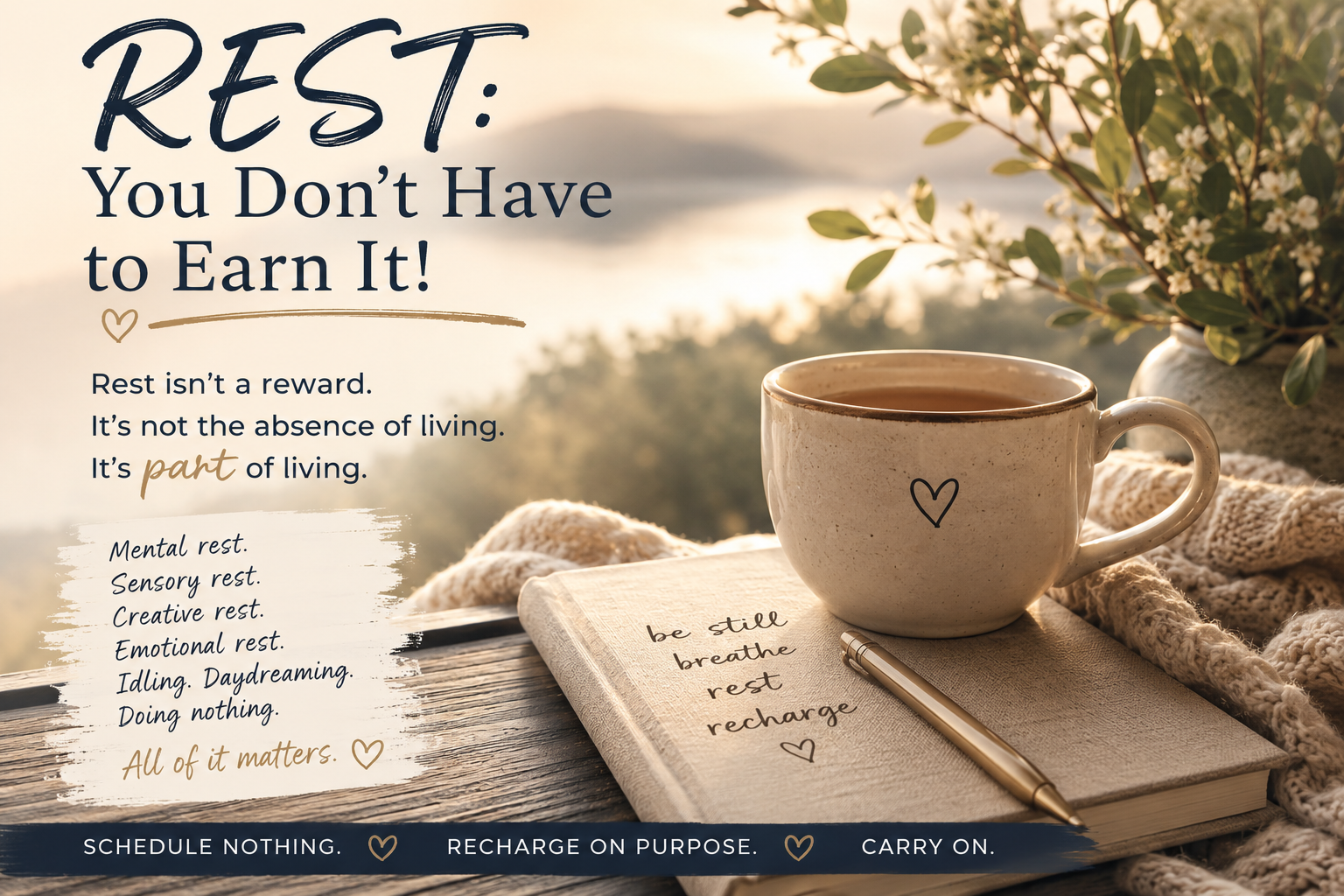
REST: You Don't Have to Earn It!
I'll Rest When...
One of my greatest challenges in self-care has been practicing recovery.
In this context, when I talk about recovery, I’m not talking about addiction recovery. I’m talking about the small moments of recovery—or rest—that refill our cups and recharge our batteries so we can continue with our day.
How many times have you shown up for work, emptied your entire energy tank there, gotten home, and had nothing left to give yourself—or anyone else?
We tend to give our employers everything because, after all, they provide the money that allows us to do everything else, right?
But here’s the thing: your employer is never going to love you back, no matter how good you are at your job. One day you can be at the top of your game and the next day, poof, you’re sacked.
Meanwhile, perhaps you’ve sacrificed time with the people you love. Friendships. Things that bring you joy. Your relationship with yourself.
I say this only to remind you that there are a lot of people and things in your life that matter more than your job. And your health matters most of all.
Because without it, you got nothing.
So the next time you hear yourself saying, I’ll rest when work is finished. When the kids are settled. When the house is clean. When everyone else has what they need...
Remember that essentially means:
Never.
Rest Is Biological, Not a Reward
Our culture has a tendency to associate rest with laziness and productivity with worth.
But rest isn’t merely about sleep.
It’s mental rest. Sensory rest. Creative rest. Emotional rest. Idling. Daydreaming. Sitting quietly for a few minutes without needing to accomplish a damn thing.
Think about your cell phone for a moment. What happens when the battery gets low?
We charge it.
And usually, we have a plan for this. Think of the last time you were at an airport and saw all those people clustered around outlets with their devices plugged in.
We don’t charge our phones because they’ve earned it. We charge them because otherwise they stop working.
Humans are surprisingly similar, but with fewer software updates.
If only we had a battery indicator on our forearms.
Then again, maybe we don’t need one.
I bet you already know when your battery is getting low.
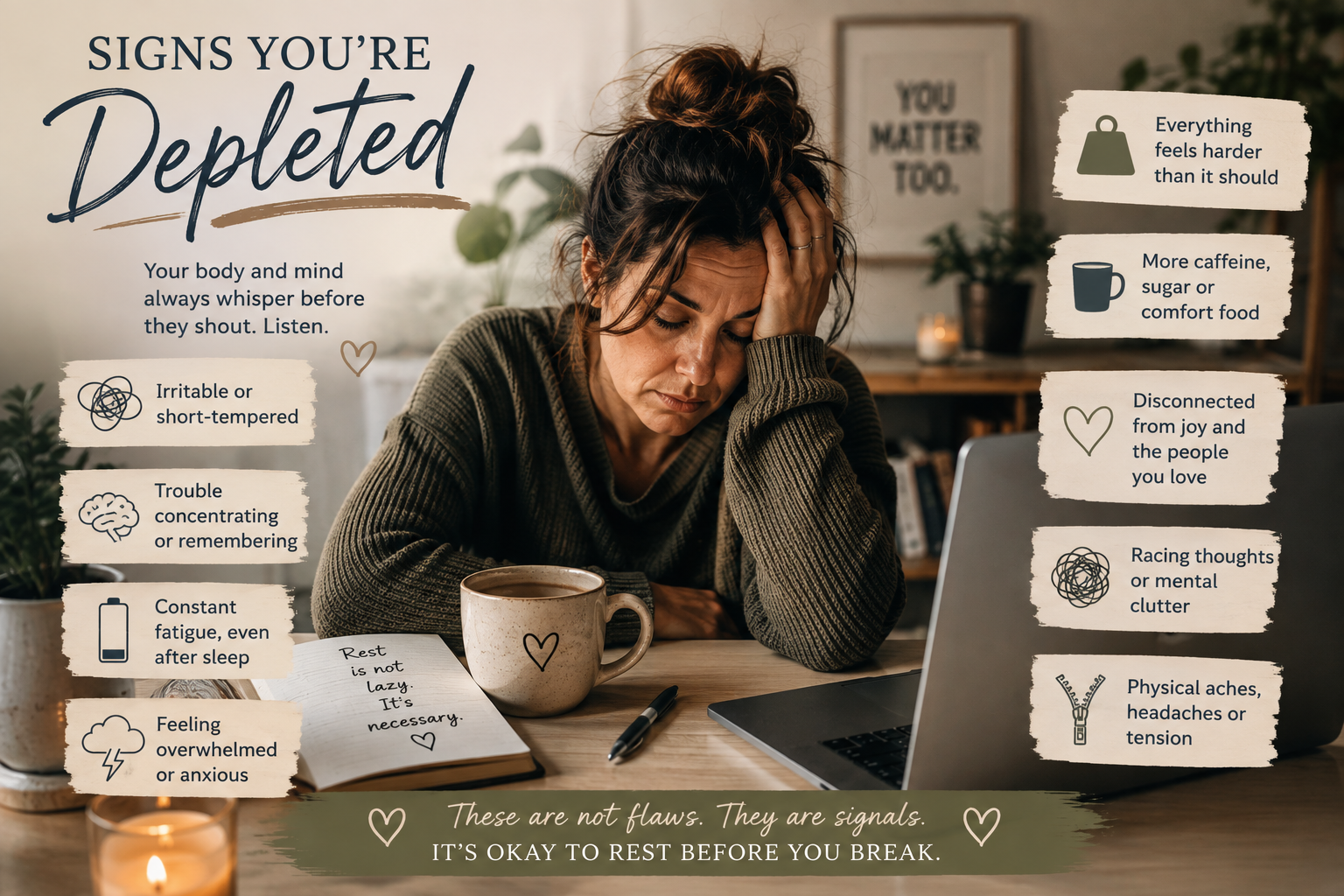
Maybe you get a little edgy. Perhaps you get short with someone or respond more tersely than you normally would. Maybe you develop a headache. Your concentration slips. Everything suddenly feels harder than it should.
Take a moment and ask yourself: What happens to me when I’m overextended or depleted?
It’s important to know what this looks like because those behaviors and sensations are signals. They are your body’s way of saying: Hey. We need to recharge.
And let’s be really honest about something.
Resting can be hard work.
Because taking a break to recharge can bring up all kinds of uncomfortable thoughts.
I should be doing something.
I’m wasting time.
Everyone else is working.
What will people think?
Sometimes doing nothing requires far more courage than doing one more thing.
The truth is that even a 15-minute recovery break—to sit quietly, step outside, close your eyes, breathe, stare out a window, or simply do nothing—can change the way you move through the rest of your day. You may return calmer, clearer, more patient, more creative, and far more available to the people around you.
So let’s practice something that sounds incredibly simple.
And may not be easy at all.
Practice: Schedule Nothing

Sometime this week, put 30 minutes on your calendar.
Call it whatever you want. Recovery. Recharge. Nothing. Mine.
Then protect it the same way you would protect any other appointment.
Here’s the important part:
You are not going to accomplish anything during those 30 minutes.
No podcast.
No errands.
No catching up on email.
No folding laundry while watching television and calling it relaxation.
No productivity cleverly disguised as self-care.
Instead, give yourself permission to simply be.
Sit on the porch. Lie in the grass. Wander around the neighborhood without counting your steps. Take a nap. Watch the clouds. Drink a cup of tea while it is still hot. Stare out the window. Let your mind wander somewhere completely useless.
And notice what happens.
You may feel restless at first. You may reach instinctively for your phone. Your brain may begin producing a helpful inventory of everything you should be doing instead.
Notice that too.
You don’t have to fight it.
Just stay.
Thirty minutes of nothing.
And somewhere in that empty space, you may discover something that our relentlessly productive culture would rather you forget:
Rest is not the absence of living.
It is part of living.
Carry On

We spend so much of our lives believing rest belongs at the end.
After the work is done. After everyone else is cared for. After the house is clean, the emails are answered, the errands are finished, and the list has finally stopped growing.
Except the list never stops growing.
There will always be another email. Another load of laundry. Another person who needs something. Another thing you could be doing.
Which means we have to stop treating rest as the prize waiting for us at the finish line.
There is no finish line.
Rest belongs in the middle of the day. In the middle of the work. In the middle of raising children and building careers and caring for people and chasing dreams.
In the middle of this messy, beautiful business of being alive.
You don’t rest because you’ve finished living.
You rest because you want enough energy to be present for it.