
The Sacred Eight: Eight Practices of Self-Care
Week One: Filling Your Cup
Over the past few weeks, we’ve spent a lot of time tuning into the richness of Lughnasadh—the ripening of late summer, the first harvest, and the quiet wisdom of noticing what has grown.
But now, another kind of season is beginning.
You can feel it in the air.
Culturally, the end of August carries the energy of a new beginning. Schools and colleges are starting again. Calendars are filling. Routines are returning. And from here, life seems to gather momentum. Every month for the rest of the year brings another holiday, another gathering, another reason to add something to the list.
The shops are already filling with decorations for Samhain. Christmas won’t be far behind.
Life is about to get busy.
Which makes this an especially good time to talk about self-care.
Not the kind we squeeze in when everything else is finished. Not the occasional massage, vacation, or bubble bath we promise ourselves when we finally have “time.”
I mean self-care as a practice.
Something we tend to every day because the way we care for ourselves now will shape the way we move through everything that comes next.
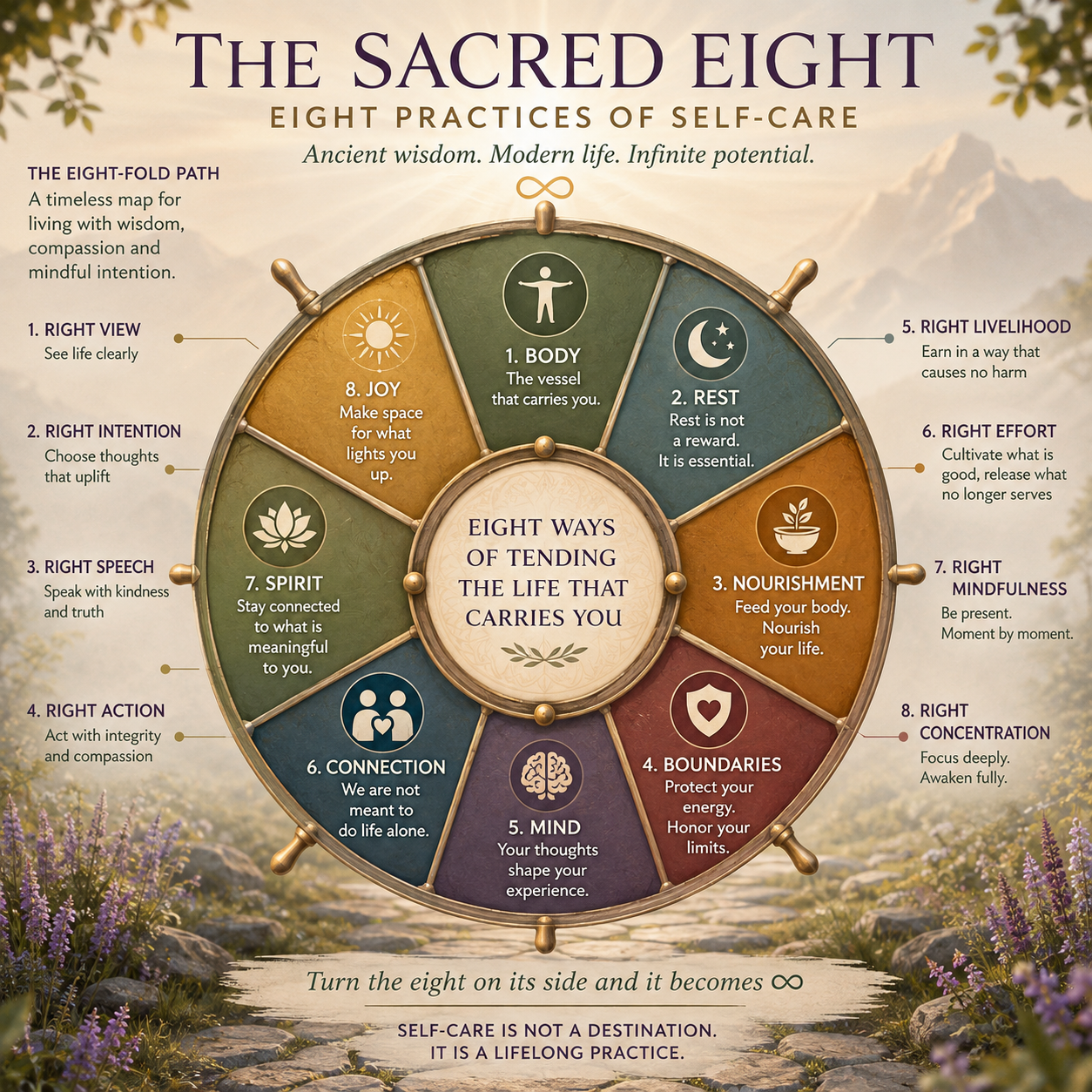
For the next eight blogs, we’re going to explore eight ways of tending the life that carries us: Body. Rest. Nourishment. Boundaries. Mind. Connection. Spirit. Joy.
This week is about filling your cup—tending the vessel itself. Next week will move inward, toward the things that give our lives depth and meaning once we have created enough space to hear them.
And there is something lovely about the number eight.
Eight carries symbolism of balance, renewal and continuation. There are eight spokes in the Buddhist Noble Eightfold Path and eight Sabbats in the modern Pagan Wheel of the Year.
Turn the number on its side and it becomes infinity.
∞
Perhaps that is the deeper invitation of this series.
Self-care isn't something we finish.
It is an ongoing relationship with ourselves.
The Body That Carries You
When Everyone Needs Something

If you are anything like me, you may have spent a good portion of your adult life putting yourself somewhere near the back of the line.
Work. School. Family. Deadlines. Responsibilities. People we love. People who need us.
And when life gets busy, what happens to our own care?
We tell ourselves we’ll get to it later. When we have time. When everything else is squared away.
Except somehow, that magical stretch of unused time never seems to arrive.
When we are younger, our bodies can be remarkably forgiving. We push through exhaustion. Skip the walk. Sit too long. Sleep too little. Carry stress in our shoulders and necks and backs and assume everything will keep working because, for the most part, it does.
Until it doesn’t.
The knee begins to ache. The back protests. The neck that has spent years bent toward a computer finally has something to say.
Suddenly the body we have been postponing becomes impossible to ignore.
But what if we didn’t wait until our bodies had to shout?
What if we learned to listen while they were still whispering?
Your Body Is Not the Support Staff
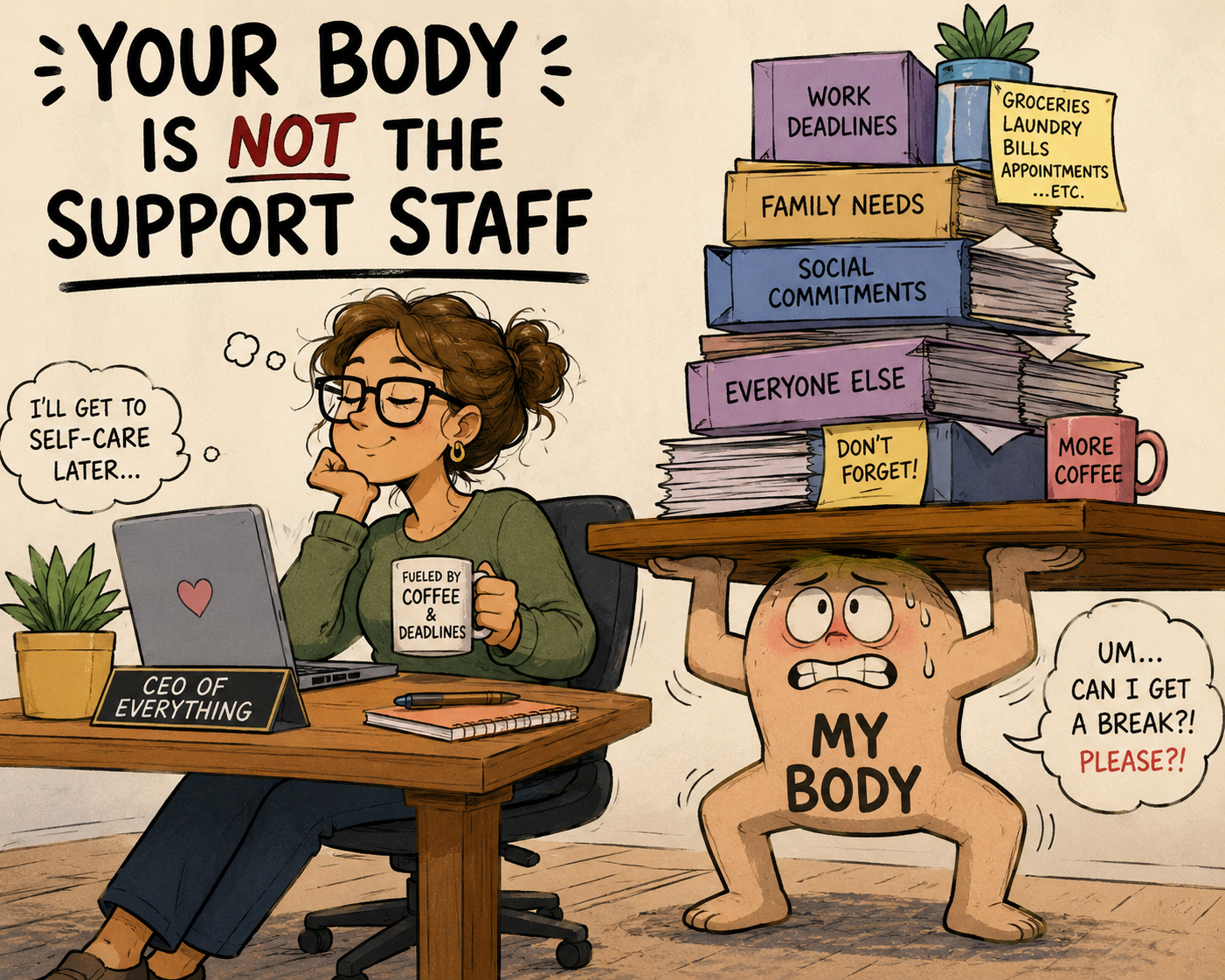
We often treat the body like the employee responsible for carrying out whatever the brain has scheduled.
Feed it quickly. Keep it caffeinated. Push through fatigue. Ignore the ache. Get through the day.
But your body is not the support staff for your life.
It is the place where your life happens.
Movement. Strength. Stretching. Hydration. Nourishment. Medical care. Touch. Sunlight. Sleep.
These don't have to become another wellness checklist filled with things we are supposed to do perfectly. Think of them instead as stewardship—small ways of tending the extraordinary living vessel that makes everything else possible.
There is an old idea that we can either invest in our health now or invest in illness later. Of course, caring for ourselves cannot guarantee perfect health. Bodies are complicated. Genetics, environment, circumstance and simple chance all play their part.
But we do have influence.
And that matters.
Much of our healthcare system is necessarily designed to respond once something has already gone wrong. That makes our own role in prevention, everyday wellbeing and advocacy especially important. We can learn our bodies. Ask questions. Move them. Rest them. Feed them well. Seek care when something feels wrong. Pay attention to the small signals before they become louder ones.
No one else can live inside your body for you.
You are its closest witness.
And perhaps self-care begins simply by becoming a better listener.
This is also at the heart of my work as a life coach. I don't believe wellbeing comes from turning our lives upside down overnight. More often, it begins with tiny shifts—small choices repeated often enough that they slowly change the way we live.
That is what I hope these next eight practices offer you.
Not another list of things to accomplish.
An invitation to come home to yourself.
Practice: Ask Your Body

I've written before about body wisdom because I find it endlessly fascinating. We carry far more information in our bodies than most of us realize. The trouble is that our lives can become so noisy that we stop hearing it.
So today, we're going to practice listening.
Three times during the day, pause for just a moment.
Take a breath.
Then ask: What does my body need right now?
Don't immediately answer with what you think it should need.
Listen.
Water?
Food?
Movement?
Rest?
A bathroom break you’ve been putting off for the last 45 minutes?
Five deep breaths?
A few minutes outside?
A stretch?
Stillness?
Then, whenever possible, give your body what it asked for.
That's it.
No overhaul. No 30-day challenge. No new identity required.
Just three moments of listening.
Because every time you notice a need and respond to it, you are practicing something much larger than self-care.
You are practicing trust.
Carry On

Self-care does not begin with doing more.
It begins with paying attention.
Before we can nourish our minds, deepen our spiritual lives, strengthen our relationships or make more room for joy, we have to tend the living vessel that allows us to experience any of it.
So as you move through today, notice your body.
Not how it looks.
Not how you wish it looked.
Not what it could do twenty years ago.
Notice the body that is here now.
The one breathing while you read these words. The one that has carried you through every heartbreak, adventure, ordinary Tuesday, new beginning and long road you have ever traveled.
Listen when it whispers.
Give it water. Give it movement. Give it rest. Give it care.
And perhaps, little by little, stop treating your body as something that must keep up with your life.
Your body isn't getting in the way of your life.
Your body is how you get to have one.