
SELF: The Stranger in the Mirror
Relationship with Self
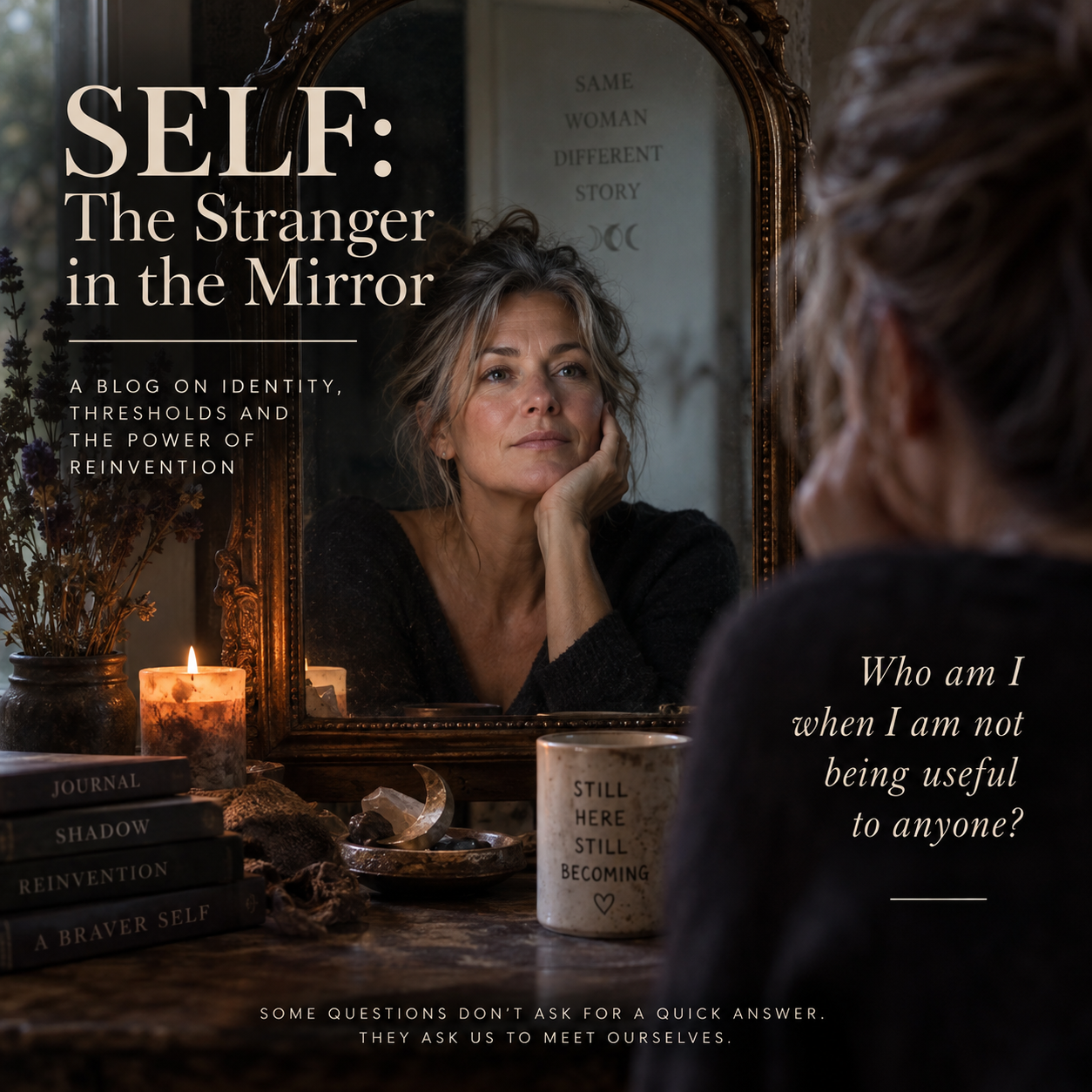
Ask someone who they are and they will usually tell you what they do, who they belong to, where they come from, or what they believe.
I’m a mother. Teacher. Nurse. Wife. Veteran. Writer. Recovering alcoholic. Runner. Democrat. Extrovert. Caregiver. Survivor.
We collect identities throughout our lives, and they serve an important purpose. They help us understand ourselves, but they also help other people understand us. Depending on whom we're talking to, we may even reach for different pieces of ourselves.
Sociologist Erving Goffman described something similar through his theory of dramaturgy: the idea that social life resembles a performance. We have our "front stage" selves—the versions other people see—and our more private "backstage" selves.
This isn't necessarily dishonest. It's human. We are complicated creatures, and context determines which parts of us step forward.
But something interesting can happen after we've played a role long enough.
We begin to believe the role is the person.
When the Costume Comes Off

Retirement invited something new into my life. For thirty years, I could tell people what I did. My career gave me titles, responsibilities, expertise, status, structure and an easy answer to that deceptively simple question: What do you do?
Then one day, I didn't do it anymore.
I was still me, obviously. And yet, there were moments when the person looking back from the mirror felt oddly unfamiliar.
I've met that woman before.
I've met her in recovery. On the Camino. At the end of relationships. In aging. In menopause. In becoming a writer. An artist. Life coach. Every significant threshold in my life has taken some version of me away and left another standing there wondering:
Okay. Who are you now?
Perhaps that is one of the gifts of thresholds. They disturb the story we've been telling about ourselves.
And sometimes they reveal how much of that story was costume.
Know Thyself

"Know thyself" was inscribed at the Temple of Apollo at Delphi thousands of years ago, which tells me human beings have apparently been trying to figure themselves out for quite some time.
Psychology now gives us language for some of this. We construct a narrative identity—an evolving internal story that connects who we were, who we are and who we believe we are becoming. A flexible sense of self can help us adapt when circumstances change.
But long before psychologists studied identity, spiritual traditions invited people into the same mystery.
Sit in silence. Keep vigil. Write. Pray. Pull cards. Walk into the woods. Look into a mirror. Meet your shadow. Stand at the threshold and ask what you are carrying through—and what needs to remain behind.
Maybe this is why Hecate, goddess of crossroads and thresholds, has always resonated so deeply with me. There is something sacred about the place between who we were and who we are becoming.
It can also be wildly uncomfortable.
Because when the familiar identities fall away, there may be a brief moment when we don't recognize the person underneath them.
The Power of Reinvention
We tend to talk about reinvention as though we are supposed to manufacture an improved version of ourselves. I don't think that's quite it. I imagine reinvention is less about creating someone new and more about becoming curious about the person who remains when an old identity no longer fits.
Who am I without the job? When nobody needs me? When I'm not accomplishing something? When I stop trying to be the person I've decided I am?
Those questions don't require immediate answers. In fact, I'd be suspicious of any answer that came too quickly.
The relationship we have with ourselves is almost certainly the longest relationship of our lives, and yet we can spend decades interacting mostly with our résumé, our roles, our responsibilities and our reflection.
There is someone underneath all of that. Maybe we can meet her.
Practice: Who Am I?
Stand or sit in front of a mirror for several minutes. Don't fix your hair. Don't examine your skin. Don't evaluate your body. Don't improve anything.
Just look.
Notice the impulse to judge, adjust, look away or narrate what you see. Let it pass. Then take out your journal and write one question at the top of the page: Who am I when I am not being useful to anyone?
Don't try to write something profound.
Just see who answers.
Take This With You
You are not only the roles you have played, the work you have done, the people you have loved, the things you have survived, or even the story you have spent years telling about yourself.
Those things belong to you. But they are not all of you. Every once in a while, life brings us to a threshold and takes away one of our familiar names. The stranger waiting on the other side may not be a stranger at all.
She may simply be someone you haven't had the chance to meet yet.