
QUIET: Why Does Silence Make Us Uncomfortable?
Quick, Turn Something On
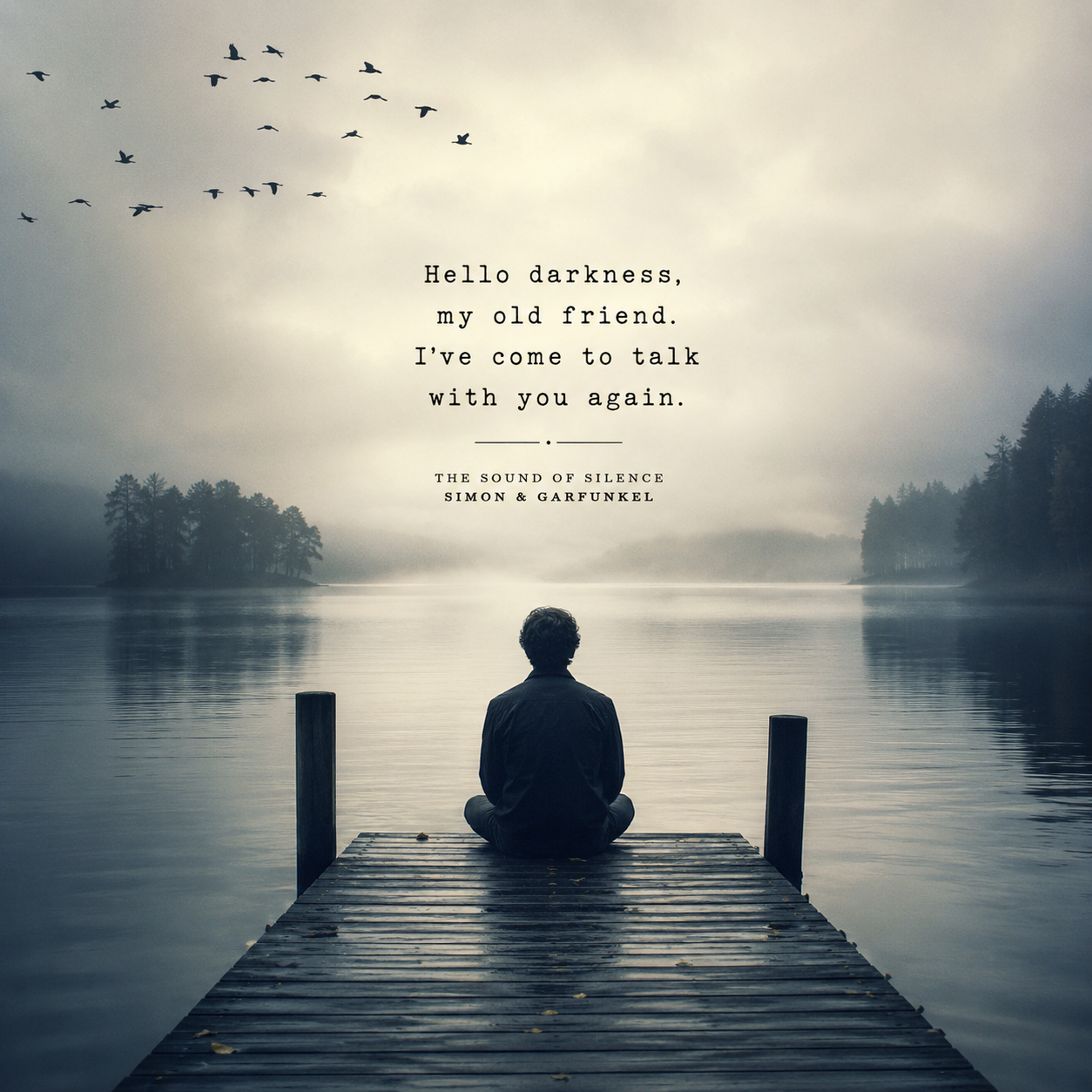
I have loved Simon & Garfunkel’s The Sound of Silence since I was in junior high.
I’m not entirely sure I understood what the song meant back then. I just knew I loved the haunting melody, the harmonies, and the strange melancholy of it. It was one of those songs that made me feel something before I had enough life experience to know exactly what I was feeling.
Decades later, I still love it.
And perhaps what strikes me most now is that The Sound of Silence isn’t really a song about peaceful silence at all. It is about disconnection. People talking without really communicating. People hearing without really listening. A world filled with sound—and yet somehow profoundly silent.
Which makes me wonder: maybe silence itself isn’t what makes us uncomfortable.
Maybe it’s what silence can contain.
Think about how quickly we fill it.
What happens when you're alone in the car without the radio? When you cook without music? Walk without headphones? Sit in your house without the television humming somewhere in the background?
For many of us, the impulse is immediate: Quick. Turn something on!
What Shows Up When the Noise Stops?
Silence can be uncomfortable for all kinds of reasons.
It can feel socially awkward. Lonely. Boring. Unproductive. We may have become so accustomed to stimulation that simply sitting without anything happening feels vaguely wrong.
But silence also carries some complicated associations.
It can be used as a weapon.
The “silent treatment” is probably one of the most painful things I can experience with another person. That sudden severing of connection feels almost like a kind of death. Someone is physically there, but the relationship has disappeared.
Silence has also long been used as punishment: Be quiet. Stand in the corner. Don't say a word.
And at its extreme, there is solitary confinement—the deliberate removal of human contact and connection.
So perhaps it makes perfect sense that silence doesn't automatically feel peaceful.
Sometimes we have learned to associate silence with loneliness, rejection, punishment or disconnection.
And then there is another possibility.
Sometimes when the world gets quiet, we can hear ourselves again.
That may be uncomfortable too.
An emotion we've been trying not to feel. A truth we've been talking over. An admission we've been avoiding. A weariness we've been outrunning. A longing we haven't wanted to acknowledge.
Noise gives our attention somewhere else to go. Silence takes away some of the hiding places.
Perhaps this is where we can begin changing our relationship with it.
We don't have to make silence sacred. We don't have to love it. We certainly don't have to sit cross-legged on a cushion and achieve enlightenment before breakfast.
We can simply become a little less afraid of it.
We can begin to discover the difference between silence that disconnects us and silence that creates space for us to reconnect with ourselves.
Practice: Five Minutes Without Filling It

Yesterday, our practice was simply noticing the noise around us. Today, we're going to remove some of it.
Find somewhere you can sit quietly for five minutes.
That's it.
No meditation required. No music. No podcast. No scrolling. No book. No task to accomplish.
And when you feel the urge to reach for something—and you probably will—just notice it.
What happens in your body?
What thoughts arrive?
What emotion might be underneath the impulse to escape the quiet?
You don't need to fix anything that comes up. You don't even need to understand it.
The practice isn't achieving serenity.
The practice is staying curious.
Take This With You
Maybe the opposite of noise isn't silence.
Maybe it's listening.
There is a kind of silence that separates us from one another. But there is another kind that creates enough space for us to hear what has been whispering underneath all the noise.
And perhaps our discomfort with silence isn't proof that something is wrong with silence.
Perhaps it's an invitation.
What might you hear if you stopped talking over yourself?