
The Quiet Power of Pen to Paper
The Science, Mystery, and Practice of Journaling
Sometimes the most powerful conversations we have are the quiet ones—between ourselves, a blank page, and the courage to listen.
I began journaling during the pandemic, and like many unexpected things born from that season, I never intended for it to become permanent.
I had tried before.
Several times.
Beautiful notebooks. Fresh starts. Grand intentions.
Each attempt eventually dissolved into abandoned pages and long stretches of silence.
Then the world stopped.
Like many people, I suddenly found myself with something I had not had in years: time.
There was less commuting. Less rushing. Less performing. Less noise. And perhaps more importantly, there was space.
At first, journaling became a companion to isolation—a place to put thoughts when there were fewer people to speak them to. A place to process uncertainty, fear, change, grief, hope, and all the strange contradictions of living through a global event.
But what surprised me was not that I started journaling.
It was that I kept going.
Years later, even after returning to work and life becoming full again, the practice remained.
Which made me wonder:
Why this time?
What was different?
What I have come to understand is that there is something unexpectedly powerful about connecting pen to paper.
And while that may sound old-fashioned in an age of voice notes, AI, and endless digital tools, the science behind writing suggests there may be something unique happening when we physically write.
Your Brain Changes When You Write
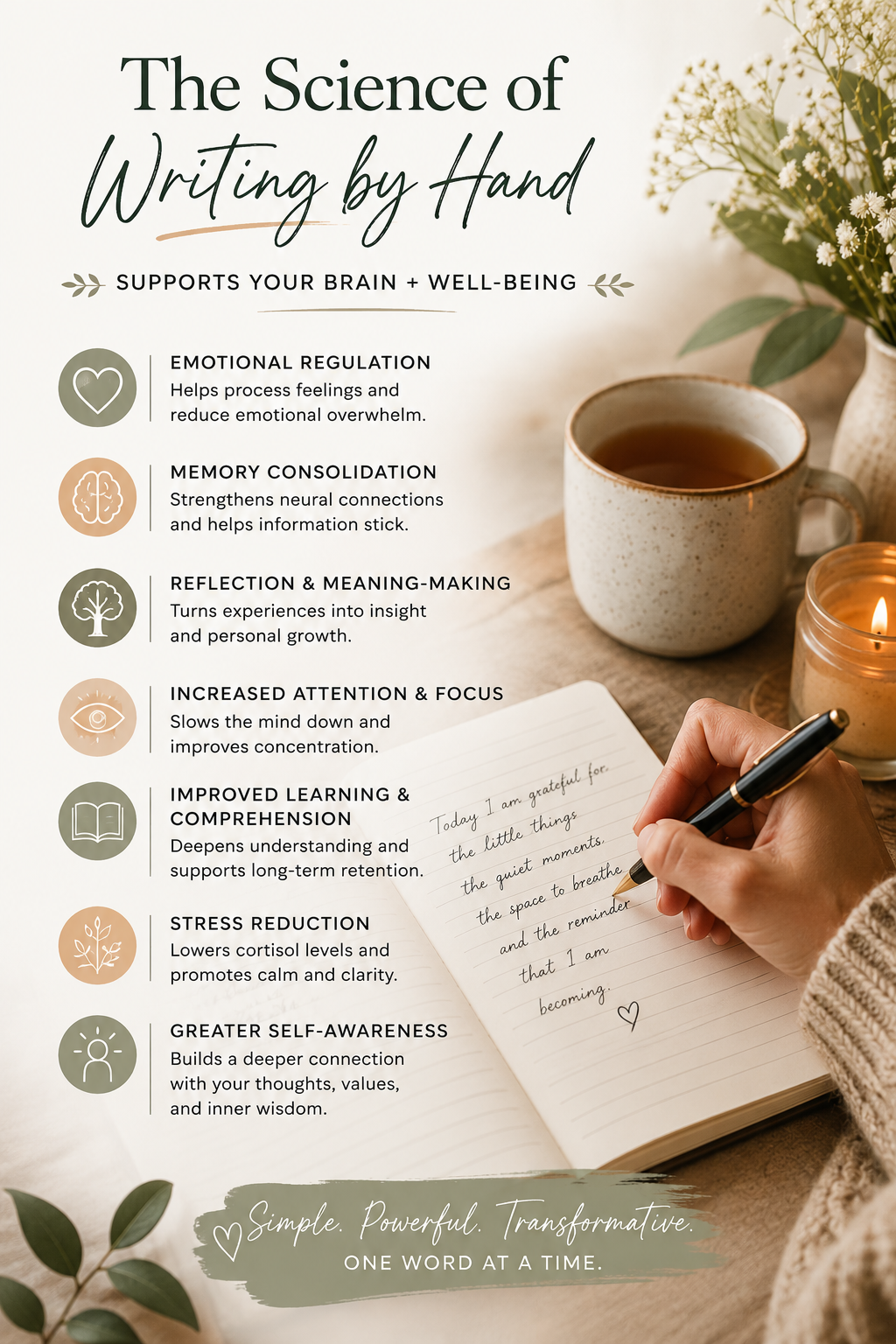
Every time you put pen to paper, you’re doing more than writing—you’re giving your brain space to process, focus, heal, and remember who you are.
Researchers have spent decades studying what happens when humans write by hand.
And the findings are fascinating.
Writing activates multiple areas of the brain simultaneously—language centers, memory networks, emotional processing regions, motor pathways, and executive functioning systems.
Unlike typing, handwriting appears to create stronger neural integration because it slows thought just enough to require deeper processing.
Writing by hand can support:
Emotional regulation
Memory consolidation
Reflection and meaning-making
Increased attention and focus
Improved learning and comprehension
Stress reduction
Greater self-awareness
One landmark area of research, often called expressive writing, explored by psychologist James Pennebaker, found that structured writing about meaningful experiences may support emotional processing and has been associated with improvements in wellbeing.
The mechanism is still being explored, but one theory suggests that writing helps transform vague emotional experiences into coherent narratives—and our nervous systems seem to appreciate that.
In other words: Writing can help move experience from chaos into meaning.
Why Journaling Sometimes Feels Weirdly Magical

Sometimes what feels like magic is simply this: giving your inner world enough quiet, enough paper, and enough time to finally speak.
I have another observation that feels harder to explain.
As some of you may know, I’ve led groups through The Artist's Way, where journaling is foundational to the entire experience.
One of the practices later in the process involves returning to earlier journal entries and reading them with fresh eyes.
Highlighting patterns.
Looking for themes.
Paying attention.
The first time I did this, I was honestly stunned.
Across page after page, I found thoughts, longings, fears, intuitions, and ideas that later unfolded in my life.
Not in some supernatural “I predicted the future” sort of way. But in a quieter and perhaps more powerful way. I had been paying attention before my conscious mind caught up. Writing had created evidence.
Evidence of values.
Evidence of patterns.
Evidence of needs.
Evidence of truths I was not yet ready to say out loud.
And I think this may be where journaling sometimes gets mistaken for manifestation.
It isn’t always that writing creates reality. Sometimes writing reveals reality that was already trying to emerge. When we write consistently, we start noticing. And what we notice often changes what we choose.
As a Coach, I See This Again and Again

Your journal does not ask you to be wise, eloquent, or certain—it simply asks you to show up and leave an honest mark on the page.
One of the greatest gifts of journaling is not productivity.
It is permission.
As a life coach, I have watched journaling become an avenue for self-expression, emotional clarity, decision-making, and organizing thoughts that previously felt impossible to untangle.
But I’ve also learned something equally important: Not everyone is ready for journaling. And that is okay. For some people, sitting quietly with thoughts feels overwhelming. For others, words are not the right doorway.
There is no rule that says journals must be neat paragraphs.
Those pages belong to you.
Draw.
Brainstorm.
Write lists.
Make maps.
Glue leaves inside.
Scribble.
Write one sentence.
Write badly.
Cross things out.
Start over.
At the end of the day, I care far less about what ends up on the page than that something moves from inside to outside.
Because expression changes things.
If You Are Journal-Curious, Try This
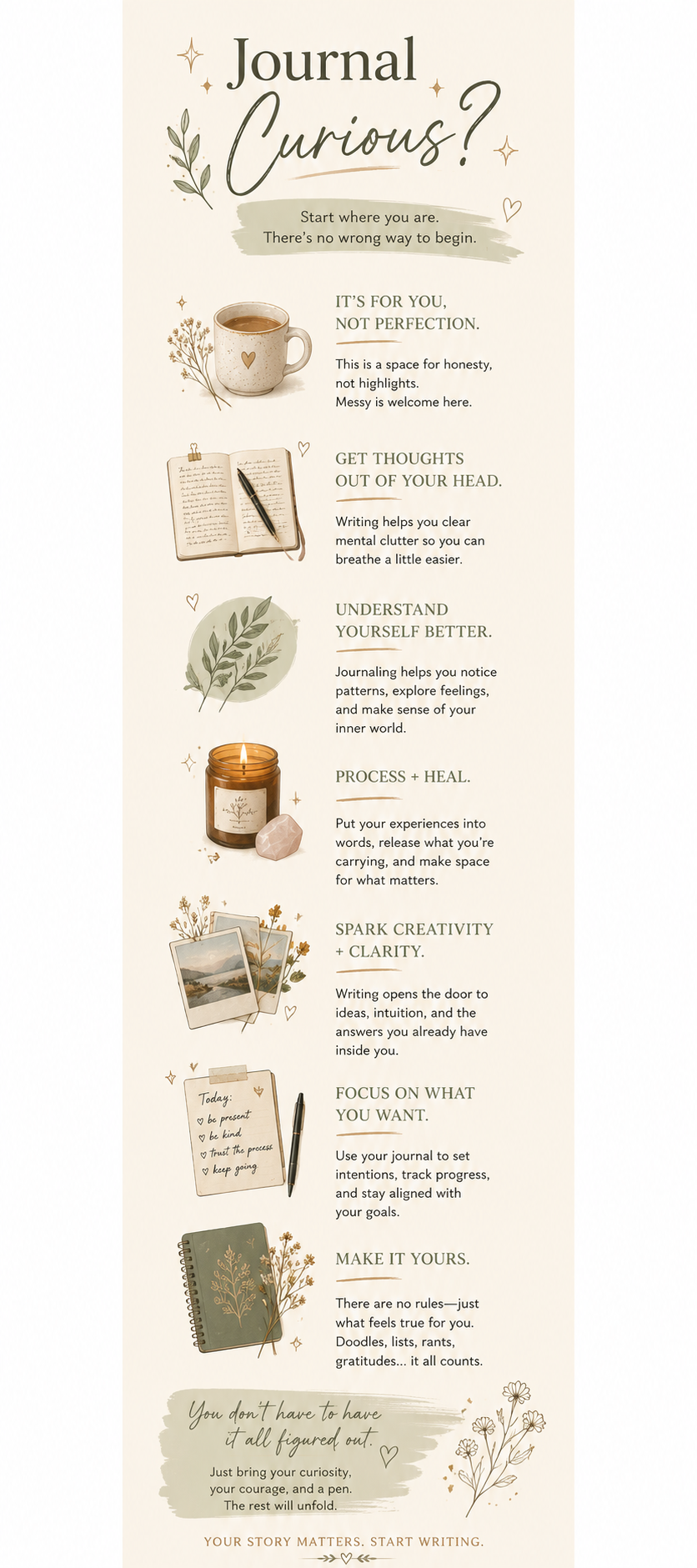
Journal-curious? Start messy, start small, start anywhere—the page is not waiting for perfection, only your presence.
You do not need to become someone who fills three notebooks a month.
You only need to begin.
1. Morning Pages
Write three pages stream-of-consciousness.
No editing.
No judgment.
No goal.
Just clear the mental attic.
2. The One-Line Journal
Write a single sentence: Today I noticed…
That’s it.
3. Questions Instead of Answers
Try prompts like:
What am I avoiding?
What feels energizing lately?
What do I know but keep pretending I don’t know?
What would make today feel meaningful?
4. Gratitude with Specificity
Skip “I’m grateful for coffee.”
Try: “I’m grateful for the way the steam curled upward while the rain tapped the windows.”
Specificity deepens experience.
5. Draw Instead
Mind maps.
Symbols.
Color.
Doodles.
Your brain does not care whether insight arrives in paragraphs.
6. Write a Letter You Never Send
To yourself.
To fear.
To your future.
To grief.
To possibility.
Final Thoughts

Long after the page is filled and the ink has dried, what remains is this quiet truth: you showed up for your own life.
We live in a culture that often rewards reaction over reflection.
Speed over presence.
Output over understanding.
Journaling asks something radically different.
Pause.
Notice.
Listen.
There is no gold star.
No algorithm.
No audience.
Just you, a page, and the possibility that somewhere beneath all the noise, you already know more than you think.
And if nothing else—
you will leave behind a record.
Not of accomplishments.
But of becoming.
—
Do you journal?
If so, I’d love to hear what your practice looks like. And if you’ve been journal-curious but uncertain where to begin, perhaps today is enough for a single sentence.
One page.
One thought.
One small act of listening to yourself.
-Dani Keating
Health & Life Coach
Coaching with Dani